Follow by Email

Thursday, March 30, 2006

Human intellect vs. śāstra and Grace-essay deleted

After due consultation I have deleted my essay "Human intellect vs. śāstra and Grace" from my website. A version with corrective comments will remain available from my archives on request. I concede to Jagat and Mādhava on the issue of literalism, but on this issue only. I do insist that especially Jagat's attitude towards the śāstras and the ācāryas is appalling.

Wednesday, March 29, 2006

Worldfamous


viśva-vikhyāta - I found this picture of yours truly, listening to a lecture on the roof of Rādhākuṇḍa's Rādhā-Gopīnāth Mandir, in the month of Kārtik last year, on the public page of Vilasa Kunja. I wonder why anyone bothers to surf to the blogspot of such an apathetic madman!

Monday, March 27, 2006

Last full day in Vraja

Vṛndāvana, March 27, 2006
The last full day of this trip to Vraja. In his Bhāgavat-pāṭh, Satya-nārāyan Dās teaches that the subtle body ages with the gross body, one feels as old or as young as one is. The ego ages along with the body, unless one is a transcendental jīvanmukta.

About tarka he says that it means one argues that there is fire wherever there is smoke, but this is flawed because rain could have extinguished the fire while the smoke is still there, or there can also be fire without smoke. Only when tarka is supported by śāstra it is acceptable - hence a tārkika is not necessarily a renegade.
The word jñāna is wrongly translated as 'mental speculation' - it is instead a highly elevated transcendental path.

Sunday, March 26, 2006

Death, responsibility and literalism: Satya-nārāyan Dās

Vṛndāvana, March 25, 2006
Satyanārāyan Dās confirms my thought that the time between one's death and next birth is a timeless vacuum, like a dream, in which one is not aware of time.

About pitṛ-pūjā he says that it is for people who are attached to their families. Pitṛloka is a 'place' where they get a feeling that they are reunited with their families. Of course this cannot really be anymore because in the next life everyone has a different appearance and location. The ultimate purpose of pitṛ-pūjā is to somehow engage in some worship. In any 'family' at 'Pitṛloka' one can become cozy with Aryama.

In hell one does not have a gross body but a subtle body named yātanā śarīra. If one had a gross body there it would die 2 minutes after being dumped in the boiling soup.

Parents and Gurus are not responsible for sins committed by their disciples and children, provided they have properly instructed them. Children and disciples are individual jīvas with their own relationship with God, who must give account of their own activities, regardless of their age. If a child is old enough to commit sin it is also old enough to consider the consequences. A Guru or parent can do no more than have the best intentions. The Bhāgavat-verse which says that the king, parent etc, gets 1/6 of the subjects' karma only counts for non-devotees. For Vaiṣṇavas counts:

sarva dharmān parityajya mām ekam śaraṇaṁ vraja 
ahaṁ tvaṁ sarva pāpebhyo mokṣyayiṣyāmi mā śucaḥ  (Gītā 18.66)

"Give up all other duties and religions and surrender to Me alone. I will release you from all sins. Do not fear."

Sat Kriyā Sāra Dīpikā and Saṁskāra Dīpikā are not written by Gopāl Bhaṭṭa Gosvami because they are nowhere mentioned as being his work. Haribhakti Vilāsa says that wearing saffron cloth is like being naked, and although that is said in the context of arcanā its a general statement because a pūjārī does not change the color of his cloth when he gets off the altar. Saffron should not be worn, on or off the altar.

According to Satya-nārāyan Dās the Sarva Samvādini text I quoted on my website (deleted now) is not supporting but rejecting literalism. The tārkikas condemned there are the literalists, not vice versa. For instance, in the 3rd canto of the Bhāgavat it is said that during the creation Brahmā gave up his body, but Jīva Gosvāmī writes in his comment that he just gave up his frame of mind. So that verse is definitely not literal.

Saturday, March 25, 2006

Lokanātha's Guru


March 22, 2006
Sītānāth's Dol-Saptamī. I shoot a pic of Giridhārī on the wooden Brajabāsī-swing in 'my' gośālā at Rādhākuṇḍa.

Lokanātha Goswāmī's Guru
Vilasakunja.com, March 18, 2006:
Q: This view seems to me to be quite problematic. Why should he (Lokanath) not accept a diksa-guru? And how could he then give diksa to Narottama?
Madhavananda Das: "He may have felt it was not relevant, given his relationship with Mahaprabhu since his very childhood, and the infusion of all divine essence this relationship effected."


This is a bizarre theory for someone who, on Gaudiya Discussions, vehemently preached the need for everyone to take dīkṣā in the proper line. This is an echo of the theory of Bhaktisiddhānta Saraswati's followers. Mahāprabhu, Lord Rāma, Lord Kṛṣṇa- everyone gave the proper example by taking dīkṣā, and then Lokanāth Goswāmi did not need it? Advaita Prakāśa (12.97-100) clearly states that he did. Why Lokanātha Goswāmi's Guru is not mentioned in the different Guru-praṇālīs is a wonder to me too, since there are scriptural claims on him by both the Adwaita Parivāra and the Gadādhar Parivāra.

Wednesday, March 15, 2006

Holi/Gaur pūrnimā 2006


(Tulasis in Yadunath's garden)


March 14, 2006
2006 Colour Holi/Gaurpurnima
It's cloudy and windy, so no weather to be soaked by Holi-liquids. So I stay inside and give Giridhārī His abhiṣekh with just raw milk. In the evening there's such a rainstorm that I doubt if I will make it to Rohini's house, but I do reach it.

Rohini supports Jai-kṛṣṇa Dās Bābā's suggestion that a manjari's cloud-coloured dress can be white too, like an autumn cloud. It's not like a widow's dress, because it can have embroidery and ornaments. An apt discussion on a full-moon night, when Rādhikā goes out dressed all in white.

March 15, 2006
Stool-Holi begins early, at 7.45 a.m., when Brijabasis, with bags of powder, begin coloring each other. Rohini's place isn't much safer than the gośālā though - at 11 a.m. scary bands of Brijabasis with black hands (stool or paint?) are roaming around the house. When I cook for Rohini I warn him against my bad cooking. He wisely replies that (Mahāprabhu told Raghunāth Dās Goswāmī) we shouldn't eat nicely. I'll remember that next time I have guests! I suppose that if I didn't bother too much about nice dressing (the other prohibition of Mahāprabhu) I wouldn't be so terrified of stool-Holi anymore!

Sridhara Swami says that forgetting God in the famous 'bhayam dvitīyābhiniveśatah'-verse (11.2.37): bhagavataḥ svarūpāsphūrtis tato viparyayo dehāsmīti means "Not having a vision of God's own form. Hence one thinks: I am the body."

An alternative reading says: īśa vimukhasya tan māyayā'smṛtiḥ svarūpāsphūrtiḥ, 'Forgetfulness of God means that one does not perceive ones own svarūpa..." Nothing about falling from Goloka here....

About the famous 'ye'nye'ravindākṣa' verse (10.2.32) he says tvayi asto nirasto'ta evāsan yo bhāvas tasmāt bhakter abhāvād.... "Having no devotion to You" kṛcchrena bahu janma tapasā paraṁ padaṁ mokṣa sannihitaṁ sat-kula tapaḥ śrutādi."After many births of penance he attains the supreme abode, nearness to liberation, birth in a good family, learning..." 'sannihita' means "close, near, at hand, proximate, prepared to, ready or", so he's not really merged in brahman yet. This shows that no jīva falls down from Brahman, this verse having been the only option that would allow such a theory.
Monday, March 13, 2006

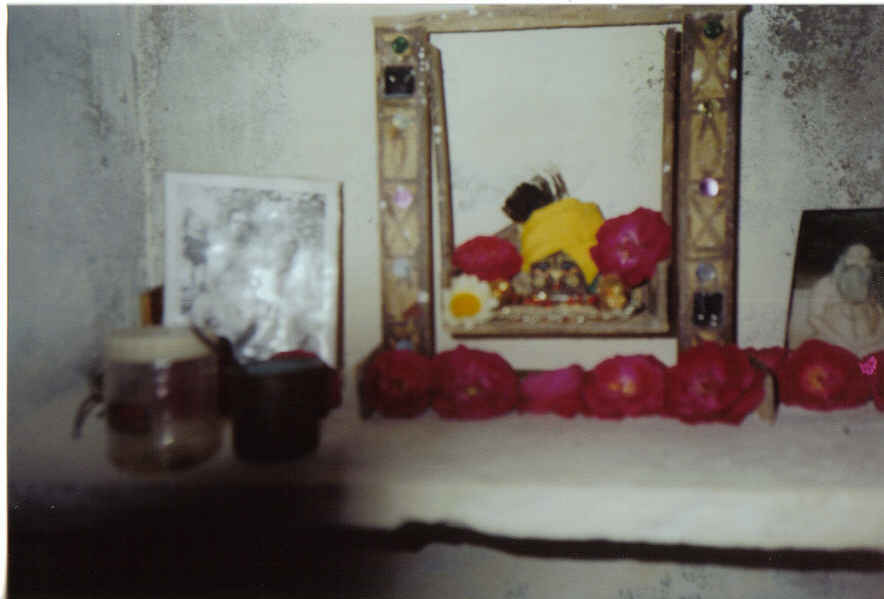
Waiting for the storm of Holi

(View of the gostha from Yadunath's back garden)

March 11, 2006
My western neighbor learned from his Guru that Holi was much dirtier before Kṛṣṇa's time (does he know about stool-Holi?) and that at Rādhā-ballabh temple in Vrindavan they put perfume in warm water for the syringes - kāntā yantra-vimukta-gandha-salilaiḥ siñcannimā dīvyati (Govinda Līlāmṛta 14.37)

March 12, 2006
Kutinati
In connection with a recent debate on a webforum about the meaning of the word 'kuṭināti', which is mentioned in Caitanya Caritāmṛta and Manaḥ Śikṣā verse 6, and which could not be found in any Sanskrit or Bengali dictionary, Haridās Dās translates it in 'Gaudiya Vaiṣṇava Abhidhāna' (vol. 2, p. 963) as kapaṭa abhinaya (masquerade, charade), chalanā (trickery) and vādānuvāda (false arguments). In his commentary on Caitanya Caritāmṛta (Madhya 19,160) Rādhā-govinda Nāth glosses it as ' sakala viṣaye kutarka' (sophistry about all issues) or kuṭilatā (crookedness).

March 13, 2006
Stool-Holi coming up on wednesday - seeking shelter in Rohini's house. This gośālā's wall is too low - Brajabasis can easily climb it!

Saturday, March 11, 2006

The Magnet of Love


(Sudevi's goshala)


March 8, 2006
The Magnet Of Love
When Mahāprabhu stayed at Candraśekhar's house in Kāśī He saw Sanātan Goswāmī through the wall of the room! Labanga Manjarī appeared dressed as a Muslim, and Candraśekhar could not recognize him even in full view, while Mahāprabhu saw him/her even through the door! tāhāre angane dekhi prabhu dhāiyā āilā (CC Madhya 20.51) 'Seeing Sanātan on the courtyard Prabhu came running!"

If the attraction of love is so omniscient and transcendental, then where is there any question whether we will meet Śrī Gurudeva again in the next life, wherever we will be born? Wasn't our meeting in this life a miracle too?

Should Vaiṣṇavas shave their skulls or wear long hair?
When Mahāprabhu's bhaktas arrived in Puri to meet Mahāprabhu for the rainy season, Mahārāja Pratāpa-rudra said to Sarvabhauma (CC Madhya 10.109): "I see these Bengali devotees don't fast or shave, though that is the rule for pilgrims arriving in a tīrtha (Puri)." Sarvabhauma replied: "Those are the rules of vidhi-bhakti, but those Gauḍīya devotees follow the path of rāga."

This proves that Vaiṣṇavas do not traditionally shave their heads, otherwise they would be already shaved on arrival in Puri anyway. Haribhakti Vilāsa says nothing about shaving.

Good I did'nt go to Barsana for Holi - it starts raining like deluge at 5 p.m. It would have been miserable!


Renovated Madanmohan Mandir at Syamakunda

Saturday, March 04, 2006

Back at Sri Radhakunda


February 28, 2006
I shift to Radhakund where I move into a windowless, but peaceful room in the Caran Cihna Mandir, me being the only occupier of the top floor. See picture above.

There is a Holi-kirtan in Syamasundar Mandir, but I stay clear from the colours and walk to Sudevi's goshala, outside of the village. She shows me how many cows, bulls and calves she has cured and how many are still suffering. She then offers me her old, abandoned small goshala as a house to stay for free. Far out to have a house of my own at Radhakund! A Brajabasi shows me the place.

March 1, 2006
This whole village shuts down at 9.30 p.m and wakes at 4 a.m. with vasanta kirtans.
The extremity of the climate - in my room at Carancihna Mandir it's so cold at midday that I must cover with a sweater and a blanket, but when I go to sit in the sun outside I scorch my feet on the hot tiles!

This year's Holi-kirtan at Raghunath Das Goswami's samadhi is not well attended - half the samadhi-mandir is empty, though the event is mentioned big in the panjika.

March 2, 2006
Thanks to Caran-cihna's rasuya pujari Giridhari had His first warm meal in 2 weeks.
I move over to Sudevi's goshala. The Brajabasis there are very honest and friendly. Holi Kirtan in Gopinath Mandir.

March 3, 2006
This goshala is the closest thing to experiencing Madangopal's life. I get a better, hardboard, bed and something needs to be done about 2 big rats that want to share the realm with me. Holi kirtan in Radhagovinda Mandir.