Monday, October 16, 2006

Mahāprabhu's own words

ekadā śrīvāsādi yoto bhaktagana
mahāprabhura guṇe gāya korena kīrtan

"One day Śrīvāsa and the other devotees sang the glories of Mahāprabhu in kīrtan"

śuni bhaktagaṇe kohe sakrodha vacane
kṛṣṇa nāma guṇa chāḍi ki koro kīrtan?

When Mahāprabhu heard it He angrily said: 'Why are you abandoning Kṛṣṇa kīrtan? What are you singing?

auddhatya korite hoilo sabākāra mana,
svatantra hoiya nāśābe bhuvana

"Everyone has become so arrogant! This independent behaviour will destroy the world!"

(Caitanya Caritāmṛta, Madhya 1, 269-271)

āmā prati sneha yadi thāke sabākāra
kṛṣṇa nāma vinā nā gāibe āra

"If you all really love Me, then sing of nothing but Kṛṣṇa!"

(Caitanya Bhāgavata)

Thursday, October 05, 2006

Continued debate on Gaura Nitya Līlā

The ongoing discussion on Gaura-nitya lila et al:
Mādhava writes in Vilasa kunja 30 september 2006-

Mādhava: "The friction arises to a great extent from the fact that the Gosvāmīs themselves wrote very, very little of Mahāprabhu at all, what to speak of touching on the specifics of Gaura-upāsanā and līlā.

Advaitadas: "This provides food for thought. Shouldn't we follow suit and thus be real rūpānugīs? Their format should be followed: They offered obeisances to Gaura once in the invocations of their books and then spoke of Rādhā-Kṛṣṇa all the way.

Mādhava: "ārati-songs for Gaura and so forth are also in practise in the line Advaitadas belongs to.

Advaitadas "That is precisely the Gosvāmīs`program - obeisances to Gaura once and then just Rādhā-Kṛṣṇa. Also our adhivāsa kīrtans are the same as in the other lines - Gaura all the way. But this is sādhana bhakti!

Mādhava: In general, there is evolution in mantras in the sampradāya - additional mantras are often learned from śikṣā-gurus and passed on to others.

Advaitadas: When you speak of evolution, isn't that like the `bold innovators` we have left other groups for? Can we call a line that `evolves` like that still a paramparā (succession)? Isn't succession meant to be unchanging?

Mādhava: On dīkṣā-mantras, the Hari-bhakti-vilāsa only mentions Kṛṣṇa-mantra and Kāma-gayatri, with passing mention of some Rāma- and Nṛsiṁha-mantras. Gaura goes undiscussed in the work (as does largely Rādhā), for it seems to be aimed at the broadest audience, not only Gaura's followers.

Advaitadas: This is untrue. In Caitanya Caritāmṛta (Madhya 24) Mahāprabhu gives elaborate instructions to Sanātan Goswāmī about the compilation of Hari-bhakti-vilāsa  It has a Gaura maṅgalācaran and is a distinct Gauḍīya Grantha. As Gaura mantra is not there and you admit the mantra`s been in use for just over a century, the conclusion is clear.

Mādhava: Curiously, Gaura-mantra is spoken of in Advaita-prakāśa, one of the very esteemed texts in the line of Advaitadās.

Advaitadas: "This I have already explained on Gaudiya Discussions and on my website www.madangopal.com: It was a procreative mantra meant only for Śacī-mātā and Jagannātha Miśra. Otherwise, it would have been received by us all nowadays, but it isn't.

Madhava: The existence of Gaura's nitya-līlā as an aprakaṭa-prakāśa is questioned. It has not been specifically addressed in any foundational works of the sampradāya, but there is no reason to assume it couldn't be there for those so willing.

Advaitadas: Can it be a spiritual reality without being mentioned in any authorised śāstra?

Thursday, September 28, 2006

Sinning in ignorance and Gaur-līlā - Satya-Nārāyan Dās

I ask Satya Nārāyana Paṇḍitjī about nāmāparādha and sinning in general in ignorance. He says nāmāparādha in ignorance is not as severe as deliberate nāmāparādha  He compares it to the woman with the baby who contaminated the kitchen , causing me to decide not to use the kitchen anymore. She displeased me, be it in ignorance, and that is just what aparādha is: displeasing. So it is with inadvertent nāmāparādha  He agrees with my point of ignorance being an excuse (see my blog of April 19) He says that in Manu Smṛti greater punishment is given to a brahmin for drinking alcohol than to a śūdra, for instance. An insane person who commits murder is not punished as harshly as a deliberate murderer. It is the intention that counts. Punishment has a purpose, it is a lesson. So yes, a westerner is not punished for drinking and meat-eating as a Hindu or Vaiṣṇava is.

About Gaura līlā he says that the personality of Gaura won't be perceived anymore as one immerses oneself in Rādhā-Kṛṣṇa līlā, but the spirit of Gaura, in which one has done Rādhā-Kṛṣṇa sādhana, will remain forever.

Satya-nārāyan Paṇḍitjī confirms that disputes have always been there in the Gauḍīya Sampradāya, though they have not been mentioned in the Gauḍīya granthas.

Tuesday, September 26, 2006

Evaporation of Gaur-līlā and the mundane Name

Vṛndāvana, September 25, 2006
Yesterday-evening I had a wonderful darśan of one of the senior-most scholars and mahātmās of Vṛndāvana. I ask him two questions. First about Bhaktivinode's statement that Gaura is to be worshipped up to the stage of ruci. He says it is up to the stage of āsakti, which is a near-twin of ruci, but the most interesting thing is that he DOES confirm that Gaura-worship evaporates at a certain stage because Rādhā-Kṛṣṇa is the sādhya. Then, at bhāva and prema-bhakti it is Rādhā-Kṛṣṇa-worship all the way. In a sense Gaura-līlā is nitya because Mahāprabhu thinks of Himself as a sakhī, mañjarī, or Rādhā, but for the sādhaka it dissolves (vismṛti, he forgets) at the stage of āsakti.

I then ask him about the theory that the holy name consists of mundane syllables if pronounced by mundaners. He confirms it, saying that the 10 offences also count for non-devotees, even though they don't know them, just like a child can be cured by medicine inside a sweet, unknowingly it will work anyway. He then quotes Bhakti Rasāmṛta Sindhu (1.3.4)

āvirbhūya manovṛttau vrajanti tat svarūpatām
svayaṁ prakāśa-rūpāpi bhāsamānā prakāśyavat

"Bhāva
(created by either rāga- or vidhi-sādhana) manifests within the mind, making it attain its real form. Though it is self-manifest by nature it appears to be manifest by the mental faculties."

Bhāva does not manifest in a mundane mind. hari-nāma is similarly self-manifest but it won't sprout on the barren ground of a non-devotee's heart."

Edited (title changed) July 28, 2008

Sunday, September 17, 2006

Spirit of Subal penetrates Vrindavan

Deity's Modern Attire Creates Disturbance
BY: STAFF CORRESPONDENT

Sep 16, VRINDAVAN, INDIA (IANS) — Priests at the Bankey Bihari temple in Vrindavan yesterday dressed up the main deity in modern attire, sparking massive protests. Priests at the temple dedicated to Lord Krishna, at the request of some fun-loving devotees, gave the deity on Thursday a modern look, complete with jeans and a shirt and wielding a mobile phone. Activists of groups like Bajrang Dal and Vishwa Hindu Parishad (VHP) termed the move blasphemy and burnt effigies of the priests. They demanded that those who defiled the sanctity of the temple be punished. Sanskrit scholars like Chandan Lal Parasher and Nirmal Giri of the Kailash temple here criticised the wanton callousness of the Vrindavan priests. The Rashtriya Lok Dal and Brahmin Sabha also organized similar protests. Some have called for the sacking of the priests.

Sunday, September 10, 2006

Familiarity breeds contempt

Everything is there in the Bhāgavata, including all folk wisdom. Today a friend quoted me this splendid verse of the Bhāgavata, about familiarity, and I like to share it here:

sannikarṣo hi martyānām anādaraṇa kāraṇam
gāngaṁ hitvā yathānyāmbhas tatratyo yāti śuddhaye

Nārada told the sages at Kurukṣetra (S.B. 10.84.31): "In the case of mortals, familiarity breeds contempt. It is like leaving the Ganges (while living on its banks) and going elsewhere for purification."

Tuesday, September 05, 2006

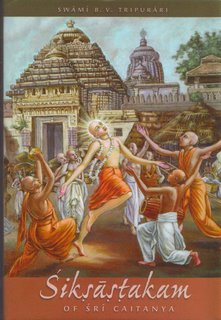
Śikṣāṣṭakam


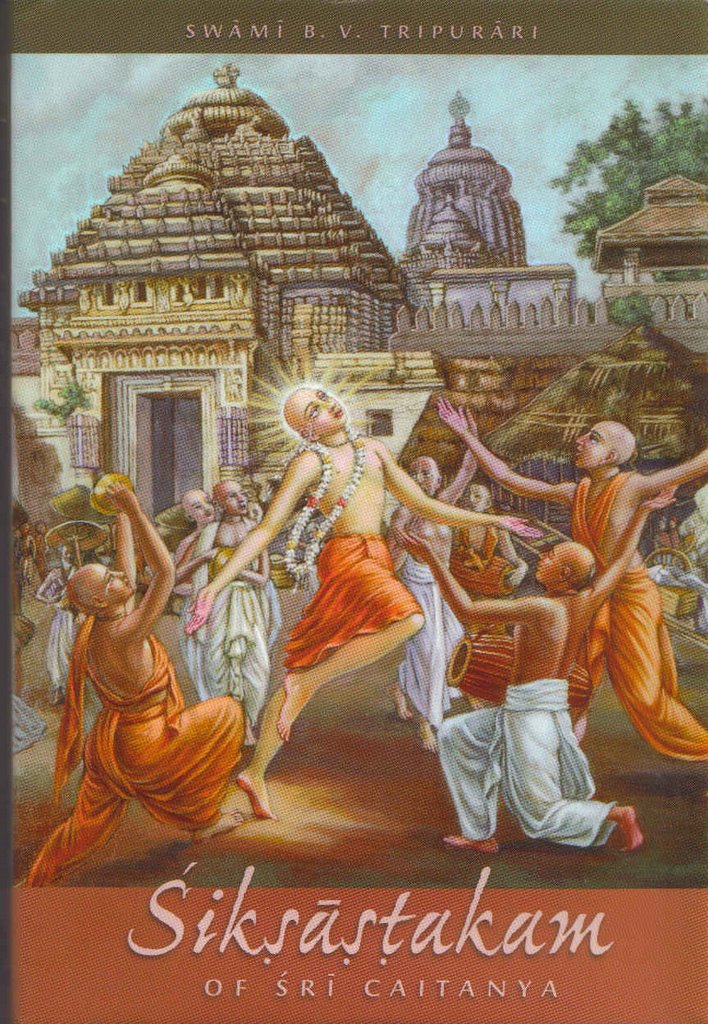
Sri Siksastakam by Swāmi BV Tripurāri

This booklet provides a very nice new elaboration on Mahāprabhu's 8 famous verses, though at various places Swāmījī did get inspired by Traditional Gauḍīya-teachings, notably in his comment on verse 5: On page 85 he makes the point of progressive revelation of the siddha deha based on SB 11.14.26, quoted from Rāgavartma Candrikā, which was first made on Gauḍīya Discussions a year or so ago. On page 86 he has quoted Narottama's āpnāra bhajan kothā nā kohibe yathā tathā and rākho prem hṛdoy bhoriyā, both cornerstone-teachings of Sādhu Bābā, quoted in his biography on my website, and on page 88 he has quoted the point Śrīla Ānanda Gopāla Gosvāmī made in his Vilāpa Kusumāñjali purports that kiṅkara(ī) means kiṁ karomi,"what shall I do?" He and a few other IGM sannyāsīs do have the habit of learning from, getting active support from and even quoting devotees that are considered taboo in their circles, without acknowledging them by name. This in itself is already not very honest, but unfortunately they (I am not sure if Tripurāri Swāmī does this too) sometimes even slam these sources as well, which is really far from proper Vaiṣṇava behaviour.

Interestingly, on page 85 Swāmījī interprets Rāgavartma Candrikā 1.9 to mean that saints, Guru or Supersoul can be alternative sources of the revelation of the siddha deha ("cultivating an inner spiritual identity"). This provides food for thought, though that is not to be literally found in the original text, nor from the context of the verse. The book does give a balanced and fair presentation of the siddha deha issue, which also raises questions about Swāmījī's sources, since the siddha deha-issue is shrouded with mystery, taboo and controversy in his circles. This booklet is fortunately more suitable to a devotee public than some of his previous publications which were clearly targeting the academics. Throughout the booklet Swāmijī gives a nice outline of Rūpa Goswāmī's rasa-tattva, which is badly needed in the western world.

Swāmī did make a few mistakes though. On page 73 he writes: "Although it is true that despite Kṛṣṇa's being primarily lost in love he nonetheless retains his Godhood and can thus hear the prayers of his sādhakas, one can legitimately ask at what stage of spiritual practice a sādhaka's prayers are capable of attracting Kṛṣṇa's personal attention and, furthermore, at what stage a sādhaka's seva becomes līlā-sevā, internal sevā that reaches Kṛṣṇa in his nitya-līlā. while some may insist that Kṛṣṇa personally listens to the prayers of his sādhakas at any stage of sādhana, Thākura Bhaktivinoda says, "The prayers of one who is a śaraṇāgata are heard by Śrī Nanda- kumāra." As we have already learned, śaraṇāgati is complete in the stage of ruci."

Interestingly enough, Tripurāri Svāmi states on page 74 that if one is disheartened by the fact that Kṛṣṇa Himself is not hearing one's prayers, the sādhaka should take solace in the fact that Mahāprabhu as Visvambhara is Jagadīśa (Paramātma) and Kṛṣṇa Himself. Therefore, the sādhaka should pray to Mahāprabhu, presumably until he reaches the stage of ruci when Vrajendranandana Kṛṣṇa Himself reciprocates with his prayers. This (typically Gaura-Kṛṣṇa bheda-buddhi-) theory cannot be verified independently. It is unacceptable that Kṛṣṇa really would not hear the prayers of anyone else but a surrendered soul. I do not know in which context Bhaktivinode says this (Swāmi quotes a song called aḍ aṅga śaraṇāgati), it may be meant as a statement of glorification but cannot be accepted as serious theology. Indeed, it is contradicted by the teachings of Viśvanāth Cakravartīpāda in Rāga Vartma Candrikā 2.1. Also, in the very end of the book (p. 128) Swami translates Svarūpa Dāmodara's famous rādhā bhāva dyuti subalitam naumi krsna svarūpam as 'Pranām to Gaura, who is endowed with Rādhā's countenance and personality'. Here 'Gaura' must be 'Kṛṣṇa'.

Page 73 furthermore contains the controversial statement that '...the baddha jivas are originally manifest from the Paramātmā', whereas from the Bhagavad Gītā it is clear that the jīva has no origin since it is beginningless - na tvevāhaṁ jātu nāsaṁ na tvaṁ neme narādhipāḥ (BG 2.12).
It is not clear what Swāmījī's source is for this theory.

As for the cover design, the artist should have been notified that before 1918 there were no saffron dhotis in the Gauḍīya Vaiṣṇava sampradāya.

The paragraph starting with 'page 73 furthermore' at the end of this blog is added January 13, 2009.

Saturday, September 02, 2006

Prema Vilāsa


While we were in Switzerland my friend Tarungovinda presented me with a copy of Bhūmipati's translation of Nityānanda Dās' 'Prema Vilāsa', which I read during my stay in the alpine āshram. The book itself is controversial enough; it narrates how Kṛṣṇadās Kavirāja died in front of Raghunātha dās Gosvāmī after he heard that his Caitanya Caritāmṛta was stolen by King Bīrhambīr, whereas he actually outlived Dās Gosvāmi for about 30 years.

There is a narration in there how Raghunātha dās Gosvāmī gave his Govardhana śilā and Gunjā mālā to Yadunandanācārya, who rendered service to them, and to Raghunātha Dās himself as well, at Rādhākund, whereas Yadunandanācārya was rather the guru of Raghunātha dās Gosvāmī, and never lived at Rādhākund, nor ever worshipped the Govardhan śilā and Gunjā mālā. Apart from that, the Prema Vilāsa is consistently anti-brāhmana, which is even aggravated by Bhūmipati dās, who was also not exactly brought up in brāhmana-friendly circles. He says that Haridās Thākur gave dīkṣā to a brāhmana named Rāma Dāsa, while the text (already biased against brāhmanas, so who knows if this story is as 'true' as the above-mentioned ones), says: tār śiṣya hoiyā viprer hoilo suddha-mati "The brāhmana's mind was purified by being Haridās' śiṣya." The word śiṣya means both 'pupil' and 'disciple', so we presume it is pupil, since Haridās Thākur is known for having no disciples at all, let alone brāhmanas.

On rāga mārga Bhūmipati writes on page 179: "Before practising rāga bhakti one must make sufficient spiritual advancement. That path is not for everyone. As long as one works under the jurisdiction of the Vedic rules and regulations one cannot serve Kṛṣṇa with spontaneity. Still, one should practise regulative devotion until his heart is firmly attached to Kṛṣṇa  Only then can he practise rāga safely." Though the original text does give a caution against whimsical speculations, the above text is nowhere in sight and originates from Bhūmipati's upbringing too.

Furthermore Prema Vilāsa mentions that Vīracandra's boat was torpedoed by Abhirāma Thākur's flute when he crossed the Gangā to take dīkṣā from Advaita Prabhu, while the Advaita Prakāśa says that he was sent back by Advaita Prabhu himself.

Having said all this, Prema Vilāsa should not be dismissed as a baby with the bathing-water either - it does provide many details about the lives of Narottama, Śyāmānanda and Śrīnivāsācārya. Also on a positive note, the book repeatedly mentions the kāma gāyatrī as a dīkṣā-mantra and mentions (chapter 24, page 276) that those in the Advaita Parivāra (Mādhavācārya or Mādhavī sakhī) serve in the yūtha of Visākhā sakhī.

Advise: read with caution, then enjoy.

Friday, September 01, 2006

Śrī Rādhāṣṭamī 2006


anulikhyānantān api sad aparādhan madhupatir
mahā premāviṣṭas tava parama deyaṁ vimṛśyati
tavaikaṁ śrī rādhe gṛṇata iha nāmāmṛta rasaṁ
mahimnaḥ kaḥ sīmaṁ spṛśatu dāsyaika manasām

(Rādhārasa Sudhānidhi – 155)

"O Śrī Rādhe! Madhupati (Kṛṣṇa) cancels innumerable offenses of anyone who even once relishes the nectarean spiritual flavour of Your name, and in great ecstasy He considers what is the greatest gift He can give to such a person. Who can then imagine the glories of someone whose mind is fixed on becoming Your maidservant?"

Thursday, August 31, 2006

In memoriam: Krishnā Dās

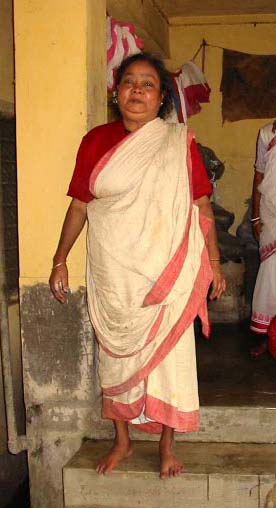
Today I received the sad news that my seniormost Guru-sister Krishnā Dās has passed away, on Tuesday, August 8th, 2006 at 5.25 a.m. local time due to diabetes. Her cremation took place on August 11th. She was born as the first of 7 children of Śrīpād Niranjan Prasād Dās in East Bengal, around the time it was partitioned from India and ceded to Pakistan, in 1947. Around 1960 the family moved to West Bengal, where they settled in Navadvīpa dhāma. Krishnā dās studied Sanskrit in Calcutta when her father met Srī Sādhu Bābā. She gave up her career prospects and joined Bābā in his then very austere āshram, becoming his first ever disciple in 1971. She started with menial services like washing pots, but gradually became Bābā's most trusted confidante, to the extent that Bābā authorised her to give dīkṣā on his behalf after his departure. She has faithfully done that for the last 20 years of her life. As a single woman she bore the heavy responsibility of managing Sādhu Bābā's āshram, organising all the festivals that are held there singlehandedly. As a life-long nun she is survived only by her 94-year old father (!)

Wednesday, August 30, 2006

Hidden motives

I read on another blog that bloggers blog to expose themselves almost narcistically for fame and prestige, to gather followers and admirers or even to seduce women. That is food for some deep introspection. My conscious motive was to get a link to the outside world, as I am physically quite isolated here. I suppose that even if bloggers, yours truly included, have vāsanās (subconscious motives) for fame, women and money, it is still worthwhile to read and write blogs because when one has a lot of knowledge it is one's duty to share the same with the wider world, and if one is unable or unwilling to travel the globe to preach one can still offer a contribution to a world which is suffering from ignorance. Also in the comments box and in its ensuing discussions, the proud blogger is able to learn lessons from his commentators......

Monday, August 28, 2006

rahasya kathā sankat


(Tarun and Advaitadas during kirtan in Spiringen templeroom)


It is hard for a lecturer to facilitate everyone - some members of the audience may not at all be ready for mañjarī bhāva and other types of confidential topics while others (including the lecturer) may be craving for this kathā. I found myself sometimes facing such a mixed audience, perhaps a bit like Śukadeva when he lectured to Mahārāja Parīkṣit's assembly. Kṛṣṇadās Kavirāja faced the same dilemma when composing Caitanya Caritāmṛta (Adi 4.231-232) :


e sab siddhānta gūḍha - kohite na juwāy; na kohile keho ihāra anta nāhi pāy. 
ataeva kohi kichu koriyā nigūḍha; bujhibe rasik bhakta nā bujhibe mūḍha.

"These topics are all confidential and should not be discussed, but on the other hand, if they are not discussed no one will know of them. That is why I will speak some confidential topics now - the rasik devotees will understand but the fools won't."

Of course one has to judge each individual audience, not that one reveals this to a large audience of ignorant novices and just one qualified rasik. In my case here, I decided to take the risk, like Kavirāja Gosvāmī did.

Sunday, August 27, 2006

Correction Vilāpa Kusumānjali


(On the veranda of Śyāma Priya Kuñja, Spiringen, Switzerland - left to right - Mādhava Dās, Advaitadās, Kṛṣṇacandra, Tarun Govinda, Subal Sakhā)


The eka-niṣṭhatā mentioned in Bhakti Rasāmṛta Sindhu 1.2.291 is not a requirement for the rāgānugā- candidate, as is sometimes mistakenly thought, but a symptom of the Vrajavāsīs. This was wrongly translated by me in my 1990-1993 editions of Vilāpa Kusumāñjali, where this translation (combined with that of the following verse) appears in the commentary on verse 57, p.224:

"Those who become greedy after the mood of the Vrajavāsī-devotees, that are called the rāgātmikā-devotees, in a one-pointed manner and that give up all considerations of scriptural injunctions logical arguments after hearing about the sweetness of their loving feelings, are the proper candidates for rāgānugā-bhakti."

The correct translation of the two verses is:

"Anyone who desires to attain the feelings of the residents of Vraja, who are exclusively fixed in rāgātmikā-bhakti, qualifies for rāgānugā-bhakti. The hallmark of the birth of sacred greed after these feelings is that after hearing of the sweetness of their different emotions the conscience disregards scriptural rules or common sense."

I have added a new pdf-file to the "literature"-linktab to my website http://www.madangopal.com/, called Vilāpa Kusumāñjali corrections, with this correction as the first entry.

Brahmins dogs

I was reluctant to blog this, but as I saw a debate going on about cats and dogs on 'gaudiya-repercussions' I decided to add my opinion here.

There is an increasing number of western Vaiṣṇavas that start keeping dogs in their house, many of them claiming a quick-fix brahminhood, taking a second birth without having the first birth to start with, saying they are instead brahmins by quality. These qualities are mentioned in Bhagavad Gītā 18.42 as śama damas tapaḥ śaucam. śaucam means cleanliness, and keeping a dog inside the house is certainly not clean - loose mammals like cats and dogs contaminate the whole house, lock stock and barrel. And such devotees usually keep deities inside their house as well! In India not even the sweepers keep dogs in their houses, so why should then the 'qualified' brahmins here in the west do so? Is there then really such a gap between birth and quality after all? How completely opposite was the attitude and conduct of Śrīla Sanātan Gosvāmī - though he was the greatest sadācārī (devotional puritan) he rather burned his foot-soles on the hot beach-path of Puri than to touch the pūjārīs of the Jagannāth Temple. Of course, Śrīman Mahāprabhu delivered Śivānanda Sena's dog, but Caitanya Caritāmṛta mentions (Antya 1.28): prabhu pāśe bosiyāche kichu alpa dūre, that the dog sat at some distance from the Lord. He did not sit on His lap or lick His face, which I have seen happening with the above-mentioned devotees. Sādhu Bābā also had a dog for a short while, but she too was kept far away from the cooking pots, the kitchen and the āśram's quarters, nor have I seen Sādhu Bābā or anyone else touch her.

A pet-loving 'brahmin' then argued that 1) Kṛṣṇa keeps two dogs too (Vyaghra and Bhramarak), but of course these are transcendentally pure eternally liberated souls, and 2) that rāgānugā bhakti is beyond rules and regulations, but that is not the opinion of Śrīla Rūpa Goswāmī:

śravaṇotkīrtanādīni vaidhi bhaktyuditāni tu
yānyaṅgāni ca tānyatra vijñeyāni manīṣibhiḥ


(Bhakti-Rasāmṛta Sindhu 1.2.296) 

"All limbs of vaidhi bhakti, such as hearing chanting etc. are also to be practised in rāgānugā bhakti. This is the verdict of the wise."

If anyone still argues that this inclusion only applies to hearing and chanting, then my question is 'when did the rāgānugā role-models Rūpa and Raghunātha keep dogs inside their kuṭīrs where they worshipped their dieties?'

Viśvanātha Cakravartīpāda comments on this verse that only meditation on Dwārkā, mudra, nyāsa and worship of Kṛṣṇa's queens are exempt for rāgānugā sādhana.

Sunday, August 20, 2006

Readings from Bhakti Sandarbha

Here in Spiringen I had the chance to read the Bhakti-Sandarbha rendering by Satya-nārāyan Dās. Here are some excerpts:

Paragraph 128 - The verses of Devahūti (SB 3.33.6-7), saying that the dog-eater who chants can perform Vedic yajñas, is not literal but only shows him being worshipable - tasmāt pūjyatva mātra tātparyam ityabhipretya. Śrīdhar Swāmī confirms it: anena pūjyatvaṁ lakṣyate.

Paragraph 152 vyādha hatasya pakṣinaḥ kukkura mukha gatasya tat palāyana vṛtyā bhagavan mandira parikramaṇa phala prāptya tādṛśatva prāptir iti -

"A bird died while in the mouth of a dog who ran around a temple and thus got liberated, since he accidentally did parikrama. "

Paragraph 153 - ādhunikānāṁ ca śruta śāstrānām apyaparādha doṣena śrī bhagavati śrī gurau tad bhaktādiṣu cāntarānādarādāv api sati bahis tad arcanādy arambhaḥ kauṭilyam

"Modern people make offences to the śāstras, inwardly disrespecting the Lord, Śrī Guru and their devotees, hypocritically worshiping them externally."

Paragraph 159 - sat sādhakasya manuṣya deha rirakṣisa jāyate sāpyupāsanā vṛddhi lobhena na tu deha mātra...

"The genuine sādhaka preserves the body for bhajan, not just for mere preservation. He is greedy to expand his worship. "

mūḍhānāṁ tu mūṣikādinam aparādhe'pi siddhis tathaiva yukta....atikramyodayat
"The mouse who ate the burning ghee-wick and thus died was an offender but he had no bad intention, so he transcended his offence at the time of death."

atha bhaktyādi kṛtābhimāna...."Pride of bhakti is caused by aparādha and results in Vaiṣṇava-aparādha."

tato'parādhābhāvāt tat kṣayārtham na tatravṛttyāpekṣā -

"Only one who is free from aparādha can chant the holy name at the time of death."

Paragraph 167 - S.B. 7.9.11 Śrīdhara Swāmī's comment - "Bhagavān is the original face and the living entity the reflection. The reflection is only beautified by decorating the original, not the reflection itself. Similarly the jīva is not gratified by pleasing himself but by pleasing Bhagavān."

Paragraph 168 - tatra caihikam niṣkāmatvaṁ bhaktyā jīvika pratiṣṭhādy upārjanam yat tad abhāvamayam api boddhavyam - viṣṇum yo nopajīvati iti gāruḍe śuddha bhakta lakṣaṇāt

"Pure bhakti means one does not perform it for a livelihood or for fame. The Garuḍa Purāṇa says one should not use Lord Viṣṇu for a livelihood."

Paragraph 172 helā tvaparādha rūpāpyabuddhi-pūrvaka kṛta ....vaiparityena badhyate

"If contempt is expressed unconsciously it does not obstruct bhakti because there is no insincerity. Those, however, who are proud of their petty knowledge and deliberately make offences have their bhakti curtailed."

Paragraph 173 - yat tu yaḥ smaret puṇḍarīkākṣaṁ sa bāhyābhyantara-śuciḥ ity ādau śraddadhānā api snānādikam ācaranti | tat khalu śrīman-nārada-vyāsādi-sat-paramparācāra-gauravād eva | anyathā tad-atikrame’py aparādhaḥ syāt | te ca tathā maryādāṁ lokasya kadarya-vṛttyādi-nirodhāyaiva sthāpitavanta iti jñeyam ||

"The fact that the famous verse says that whoever remembers Pundarikaksa is pure within and without does not mean one should not bathe. One must uphold the dignity of the sat parampara of Narada and Vyasa, otherwise one commits an offence."

yasmāc ca śaraṇāpattau vakṣyamāṇāni ānukūlyasya saṅkalpaḥ ity ādīni liṅgāni | tathā vyavahāra-kārpaṇyādy-abhāvo’pi śraddhā-liṅgaṁ jñeyam | śāstraṁ hi tathaiva śraddhām utpādayati |
ananyāś cintayanto māṁ ye janāḥ paryupāsate | teṣāṁ nityābhiyuktānāṁ yoga-kṣemaṁ vahāmy aham || [gītā 9.22]

About the process of surrender it is said: "One should accept what is favorable and reject what is unfavorable' etc. One should know that a symptom of faith is also the absence of mundane miserliness. Scripture also demonstrates this type of faith, as in Bhagavad Gītā 9.22 - "For eternally engaged devotees, who worship Me by thinking of Me exclusively, I carry what they lack and preserve what they have".

In other words, miserliness is a result of devotee's lack of faith that, when he has spent his last cent, Kṛṣṇa will not provide his next money."

The ill behaviour described in Bhagavad Gita-verse 9.30, 'api cet suduracaro' is sinning on strenght of the holy name, the 7th offence to the chanting of the holy name; the verse only serves to glorify bhakti (bhakti prasamsayam eva) and is not to be taken literally.

My own separate realisation: An initiated devotee is no more obliged to his pre-dīkṣā-teachers: dīkṣā-kāle bhakta kore ātma samarpana, sei kāle kṛṣṇa tāte kore ātma-sama' "At the time of dīkṣā the bhakta surrenders his very self - Kṛṣṇa then considers him equal to himself." (CC Antya 4.192) When meeting the sat Guru one should erase everything that preceded.

Gita quote 9.22 added December 27, 2012, originally posted on MSN spaces July 18, 2005

Saturday, August 05, 2006

Origin of the siddha deha


This is the gist of a discussion I had with Kṛṣṇa Dās (Robert Gafrik PhD Slovakia) on the siddha deha:

Advaitadās: In connection with the origin of the siddha deha the following text is quoted from Prīti Sandarbha (10):

vaikuṇṭhasya bhagavato jyotir-aṁśa-bhūtā vaikuṇṭha-loka-śobha-rūpā yā anantā mūrtayas tatra vartante tāsām ekayā saha muktasyaikasya mūrtir bhagavatā kriyata iti vaikuṇṭasya mūrtir iva mūrtir yeṣām ity uktam

"In the spiritual world, the Supreme Lord has unlimited spiritual forms; they all are expansions of Himself illuminating that world. Of these mūrtis Bhagavān gives one mūrti to each liberated soul. Their mūrti is like the one of Lord Vaikuṇṭha."

The translation is mine, but I am getting my doubts about the word kriyata here. Some people say that this word means that Kṛṣṇa is creating a spiritual body for the soul here."

Kṛṣṇa Das: "The root kṛ  in Sanskrit can actually have any meaning, it does not mean just "create". It is akin to the English "do". One can express every activity with it. Kriyate in the passage does not mean that the spiritual body is created. The text itself says that mūrtayas tatra vartante, they are there eternally, tāsām (out of them) ekayā saha (with one) muktasya (of the liberated) ekasya (of the one) mūrtir (body) bhagavatā (by the Lord) kriyate (assign), i.e. the Lord awards one of the bodies that eternally reside in Vaikuṇṭha (in an inactive state) to the liberated one. vaikuṇṭasya mūrtir iva mūrtir yeṣām, the body that one is given is similar (iva) to that of Lord Vaikuṇṭha. Jīva Goswāmī wants to explain that one achieves bhagavat-tulyatvam at the stage of utkrānta-mukti (gone forth or out, gone over or beyond , passed , surpassed, trespassing , exceeding – Monier Williams) by quoting the Bhāgavata verse (3.15.14 vasanti yatra puruṣāḥ) there (utkrānta-mukti-daśāyāṁ tu teṣāṁ bhagavat-tulyatvam evāha). There is nothing like that that the spiritual body is created at some time. It is eternal. It is aprākṛta. The fact itself should make it clear that it can't be created. "

Advaitadās: "Thank you for that. The word kriyata is the key to the whole issue and as you said it can have any meaning. That makes it extra hard and intriguing. The word vartante means 'they stay there eternally' because it is in present tense and Jīva Gosvāmī said that present tense indicates eternity? And also your addition 'in an inactive state' is not clear to me from the mūla text. If we cannot come to a definite conclusion about the Prīti Sandarbha text, is there any other text in śāstra you could provide to prove your point that the siddha deha is not created?"

Kṛṣṇa Das: "As far as I know there is only the discussion in Prīti Sandarbha and the prayujyamāna-verse (SBhāgavata  1.6.28 or 29, according to edition) with commentaries that deal with the siddha deha. Apart from that there is a discussion about this issue in the 4th chapter of Vedanta-sūtras, where it is said that the liberated soul can exist with or without a body. It would be good to see commentaries of the ācāryas on the sūtras. I don't have them here now. If both meanings are possible one has to see the context. And I would say that the context rules out the interpretation that the body is created because in the previous sentence Jīva Gosvāmī says that mūrtayas tatra vartante. They are there and the Lord gives (kriyate) one such form to the devotee. This is a natural sequence. Otherwise one will have difficulty to explain why he says that the mūrtis are already there. Yes, vartante is in present tense; more precisely, it is something we would call present simple in English, and the tense mostly indicates that something happens or is always, ie. eternally. The verb vartante itself denotes existence. In addition, siddha-deha or spiritual body cannot be created because it is transcendental. We can say only about material things that they are created. The logic behind my phrase "in inactive state" is that we are limited by our language and our experience when we talk about transcendental things. These things are actually acintya but we need some explanation so we say that it is in an inactive state before one is awarded such a body. The verse from Bhakti Rasāmṛta Sindhu (1.2.294-5) about siddha-deha does not mean that the body is created. My Guruji once told me that it descends into the mind of the devotee in a "shadow" form. It is eternal but makes itself manifest in the mind. The body has a beginning only from our material perspective."

Wednesday, August 02, 2006

Dīkṣā-paramparā

On Vilāsa-kuñja, Mādhavānanda Dās wrote an excellent article on the relativity of the dīkṣā-paramparā  Indeed, we in the first generation of Western Traditional Gauḍīya Vaiṣṇavism have over-emphasized it mainly because we were taught such over-emphasis by the senior Vaiṣṇavas we consulted at the time. At that time, in my zeal I hardly noticed that Sādhu Bābā did not really emphasize it all that much, though he did note that such a paramparā should be there. I found this entry in my Indian diary, December 1982:

"I try to incite Bābā to saying something about the value of an unbroken guru paramparā. Bābā reacts coolly. He does not seem to find it as important as I do, since I was educated in an institution without paramparā and just left that place half a year ago. After I insist several times he finally says: guru paramparā yadi ṭhik ṭhik nā thāke bhajane siddhi hobe na “If Guru-paramparā isn't exactly there you cannot have success in bhajan”.

I said it before and I will say it again - many devotees with an unbroken dīkṣā-paramparā, both Indian and Western, have fallen down and are falling down, so certainly taking dīkṣā in an unbroken paramparā is not a hocus-pocus-wave-the-magic-wand-and-u-r-instantly-siddha magic. It takes surrender to attain siddhi and nothing less than that. I also agree that those who insist that 'all-you-need-is-dīkṣā-paramparā' can be classified as kaniṣṭha adhikārīs - arcāyām eva haraye pūjāṁ yaḥ śraddhayehate....sa bhakta prākṛta smṛtaḥ (SB 11.2.47) Those who believe only in ritual (which dīkṣā basically is) worship of Hari are mundane devotees." So Sādhu Bābā said one should take dīkṣā,  Haribhakti Vilāsa and Bhakti Rasāmṛta Sindhu say we should take dīkṣā, but there is obviously more to it than just that.

Concerning dīkṣā vs śikṣā-guru - one should recognise the dīkṣā-guru in the teachings of the śikṣā-guru and never worship the śikṣā-guru separately. Those who quote S.B. 11.9.31 to prove that one can have many gurus should read Śrī Viśvanātha Cakravartīpāda's comment on it:

"One must worship a single Guru who knows Me, as is said in the 3rd chapter of the 11th Canto: "Surrender to a Guru and ask him about the highest welfare." Even Śvetaketu and Bhṛgu did not take shelter of many Gurus. Surely the only worshipable Guru is the one who instructs in My mantra. One can, however, consult śikṣā-gurus to find out what is favorable and unfavorable to one's upāsanā. Hence only to strengthen one's knowledge this verse says that there are many śikṣā-gurus. Gentle people only take learned and wise men as śikṣā-gurus  There are many sages like Gautama who follow different opinions but I will only seek those teachers who are similar minded to me."

Link to Vilasakunja deleted 13-1-11, site went offline.

Saturday, July 22, 2006

Transcript Nāṭaka

On request, here is a transcript of the new audio uploaded to www.madangopal.com (see linktab 'Sādhu Bābā audio there), in which Nirañjan Bābu and Sādhu Bābā read from his drama about Advaita Prabhu. The first 3 minutes describe how Sadāśiva petitioned Mahā-viṣṇu to save the helpless souls in the age of Kali (that made Them ultimately become Advaita Prabhu Together), the last 2 minutes describe a loving exchange between Advaita Prabhu and Haridās Thākur. The recording was not very clear and some words are not well audible, so the following translation is a rough sketch:


Niranjan Bābu, first minute:
“As the river of time rolled on, the age of Dwāpara came to an end. I dont know what is the plan of Fate now? I am very eager to know what will happen in the future. Who knows what will happen? There’s no need to worry or be unhappy. I saw Mahāviṣṇu reclining on the causal ocean while Sadāśiva was engrossed in meditation on its shore for 750 celestial years. Dressed in treebark, His head beautified by the crescent moon, terrifying snakes slithering around His armpits and flanked by His trident, He was meditating there with His head straight, worshipped by the Munis. How beautiful was the sight!”

Sādhu Bābā, next two minutes:
“The wheel of time cannot be stopped and is harsh. Nārāyan...Nārāyan... Who can stop the Great factor of Time? Wake up Lord, wake up! The age of Dwāpara has ended, King Kali is entering - he is very wicked and full of irreligion. All souls will have a bleak Fate now....(Sadāśiva) sits on the shore of the Causal Ocean in meditation, anticipating the arrival of King Kali. Your creation will be devoured by violence, vice and irreligion - what will be the remedy? Kali is merciless and hard as stone. What an awful fate...Your beautiful creation will be a abode of demons and will be filled with the pitiful cries of their innocent victims. There will be no more consolation of truthfulness in the three worlds. Anacaris (ill behaved people) will devour the world without thinking twice. How much can helpless and weak souls – men and women, their heads bowed down - tolerate this merciless thrashing? Will the clear light of virtue be polluted by the mud of sin? You promised (in Bhagavad Gītā 9.31) na me bhakta pranaśyati (“My devotee will never perish”)? Have you forgotten that, O Lord? That would be impossible for You. I am Sadāśiva – I will benefit helpless souls. I cannot tolerate Kali’s misbehaviour. You have the power of Mahāviṣṇu, I know. You wont break Your word. So rise, rise My Lord, O cause of the universe, O Paramātma of the Yogis! Give me the strength.... (Sādhu Bābā’s speech on this topic ends here on the tape..)

Then Niranjan Babu speaks for 1 minute on the relationship between Advaita Prabhu and Haridās Thākur, not well audible, but he basically describes how Haridās Thākur begs Advaita Prabhu for ruci for harināma japa and permission to seek a secluded place to relish harināma.

Sādhu Bābā, in the last 2 minutes, recites the rest of the dialogue:

“I am very happy to hear what you said. Whoever will do bhajan will speak like you. Unless you seek solitude you cannot do bhajan. Aha, are you so eager to enter solitude? Go then, I am very pleased. Its hard for me to bid you goodbye, but I know you must go.”
Haridās: “Dont touch me, Prabhu, dont touch me! I am a low and fallen Yavan.”
Advaita Prabhu: “If My caste is lost by touching you, then let it go, I dont care about that. I dont belong to any tradition, I am Sadāśiva. I have drunk the Kālakūt and Halāhala poisons (from the milk-ocean) and distributed nectar to the demigods – wouldnt I then be able to redeem even one human Yavan? And you are not a Yavan either, Haridās. You have attained the unstoppable japa of the holy name. Through you the glories of the holy name are revealed.....”
Haridās: “Prabhu, I have attained your blessing, the strength and your permission to accomplish my task – what more could I want?” (From here on the tape is quite inaudible. Hopefully in the future I will find out more)

Wednesday, July 19, 2006

108 gopī-beads?


I was wondering if there is any scriptural evidence for the widespread belief that the 108 beads of our japa-mālā represent 108 gopīs or 108 Upaniṣads. A Google search brought up many such claims, not only from Vaiṣṇavas but also from jñānīs, yogīs and academics, but none of them quoted any evidence. A scan of Haribhakti Vilāsa also brought up nothing. Is anybody able to quote any scriptural evidence?

Sunday, July 09, 2006

11-13?


Today I received this message:

Sorry if I am not giving you additional but I think you are one of the authority on this topic. This question was posed on a forum today:

Radhe!!
Yesterday I had a talk with a nice devotee who is pretty familiar with (Ananta Das) Babaji Maharaja´s books. He told me hat he was very very disturbed about the fact that Krishna actually has sexual intercourse with many many gopis who are between 11 and 13 years and that He only thinks of this to whole day. He said that he is totally uncomfortable with believing in "this aspect" of his deity, since (his words) here in this world we go to jail for having intimate relationships with persons under the age of 18. And he said: "Don't come with the "all-is-transcendental"-argument...


Since I am totally in maya, I could not say anything. In fact, I was feeling uncomfortable too. Any help???


This is a very basic question. The answer is given nicely by A.C. Bhaktivedānta Swāmijī in his books - this is the exchange of the Supreme Lord with His internal transcendental pleasure potency, which externally looks like a sexual affair of teenagers. And I DO come with the 'its-all-transcendental' argument, because it IS. Another correction which is needed is: The gopis are not 11-13, mañjarīs are of that age, but sakhīs, with the exception of Anaṅga Mañjarī, are 14. Most girls in the west, regardless of the age of consent, are either coveting boys or are already engaged with them at the age of 14. Vedic culture has girls married at such a young age exactly for that reason. Our friend's friend has no idea of Vedic culture and no idea of Vaiṣṇava theology either, so it is better he takes shelter of a sat Guru who will show him the light before he starts reading the most intimate literature in connection with Kṛṣṇa. Without a proper foundation of siddhānta (philosophy) there can be no real understanding of rasa or līlā. Again, it makes me feel uncomfortable at publishing these intimate books....