Thursday, June 24, 2010

Śrīmad Bhāgavat, Canto 3, part 1

This is the first of a series of blogs on some of my favorite commentaries on Śrīmad Bhāgavat, primarily the 3rd and 4th canto. The commentaries are by Śrīpāda Viśvanātha Cakravartīpāda, unless mentioned otherwise-

2.9.32 Lord Nārāyan tells Brahmā: "By My grace, you shall have true knowledge about Me, as to how great I am, what is My essential character, in how many forms I manifest Myself, what virtues I possess and what My activities are. "

Viśvanātha Cakravartī's ṭīkā says: "Knowledge which is beyond the senses and which is true should appear to some degree to theists who are pure and have faith. Vijñāna refers to the realization of that entity beyond the senses, direct vision of My svarūpa as it is. This can not occur without prema- and sādhana-bhakti, knowing the Lord gives His blessing for that purpose. ..... By a gradual increase of sādhana- and prema-bhakti, that are special features of the Lord's mercy-potency, one gradually realizes the Lord's sweetness more and more. It is indicated here that 'eventually you will realize the most rare and sweet form of Mine as Kṛṣṇa in Vraja-bhūmi.' This (rūpa-guṇa-karmaka) naturally defeats the notion of any type of indistinct abstract realization like Brahman."

Brahmā is the greatest intellectual in the universe and he still needed the Lord's blessings for understanding things. That shows once more that mundane brain-salads alone do not lead to spiritual realization or understanding.

3.6.23-24 The moon-god entered the heart of the giant form of the universe - the moon-god presides over the mind, which indicates that the mind is in the heart. Vijayadhvaja Tīrtha comments - hṛdaya mano vāsa-sthāna 'The heart is the abode of the mind'. Viśvanātha also comments on SB 3.26.61 hṛdaya eva mana ādy-antaḥ-karaṇa-catuṣṭayasyādhiṣṭhānam - "The whole fourfold subtle body, including the mind, is situated in the heart."

3.7.9 Viśvanātha Cakravartī shows here one should not theorize about the reason why we are in the material world, like for being 'envious of Kṛṣṇa' or even 'to learn how to love God' etc - anādyavidyā saṅgavaśāt jīvena sva jñānānandaṁ vismṛtya dehābhimāna prāptaṁ deha dharmaṁ durbhagatvādikañca prāpya yadi kliśyate tarhi kasmai doṣo deya iti  "Because of association with beginningless ignorance the jīva has forgotten his blissful and conscious nature and has developed a false ego in the material body. He suffers due to acquiring bodily characteristics and misfortune, therefore no one is to be blamed."

3.7.10 — More of the same here - tatra bhagavataḥ pṛṣṭha sthitayā anādyavidyayā tamaḥ svarūpayā anādi vaimukhya rūpa bhagavat pṛṣṭha-sthānāṁ jīvānāṁ jñānam yallupyate tasya na vastutvam kāraṇam nāpi prayojanaṁ kim apy asti "Ignorance, which is beginningless, is situated on the Lord's back. She covers the knowledge of the jīvas who are situated on the Lord's back and are non devotees. Their non devotion is anādi. There is no real reason or purpose for their knowledge being covered."

3.7.16 - And yet more - "O learned Maitreya! You have accurately explained how the external energy, whose actions which are without purpose and without cause is under the shelter of the Supreme Lord, and you have explained how the jīva's bondage, which is without purpose and without cause, is under the shelter of the Lord's māyā. Except for that māyā, then is no other cause for the universe. ....The bondage of the jīva by ignorance, and the resulting misfortune of losing knowledge (ātma-māyāyanam), is under the shelter of māyā. This is also without a goal and without a cause."

3.7.20 — kiṁ ca seyaṁ mahat sevaivāti durllabhetyāha alpa tapasā iti lokarītyoktir mahat sevāyāṁ tat kṛpaika labhyatvena tapaḥ phalatvābhāvāt vaikuṇṭhasya vartmabhūteṣu tad bhakteṣu nityaṁ sādhana sādhyāvasthāyāṁ. “That the service of great souls is very rarely attained by those of scant penance is a popular saying (loka-rīti-ukti), for the service of the saints is attainable by their grace alone, it is achieved by the devotees (Vaikuṇṭha-vartma) without the fruit of penance as the eternal practise and goal.”

3.9.11 te sādhaka-bhaktāḥ sva sva bhāvānurūpaṁ yad yad dhiyā bhāvayanti tat tad eva vapus teṣāṁ siddha dehaṁ praṇayase prakarṣeṇa tān prāpayasi aho te sva bhakta pāravaśyam iti bhāvaḥ 
"Whatever the sādhaka bhaktas meditate on, according to their own feelings, the Lord will make them a siddha deha accordingly, which they will attain. Aho! This is how the Lord is subdued by His devotees!" The words sva sva bhāvānurūpa make it clear that the siddha deha is not a diktat from the Lord above, but something which spontaneously develops in the heart of the sādhaka / sādhikā.

3.9.12bhaktena sarva-bhūteṣv eva dayā kāryaiva tad api na sarva-muktir draṣṭavyā. nahi sarvatraivoptāny api bījāny uṣara-kṣārādi-bhūmiṣv api prarohantīti - "The devotee should be merciful upon everyone, and yet we do not see everyone getting liberated. (The clue is: ) Seeds can be sown everywhere, but still they will not sprout on saline or barren ground."

3.9.21 Brahmā prays to Garbhodakaśāyī Viṣṇu when He wakes up: he mat-prabho kṛpā-pārāvāra jāgṛhi jāgṛhi kiṅkaro’haṁ maṅgalārātrikaṁ karavāṇīti bhāvaḥ "O Lord, ocean of mercy, wake up wake up I am your servant, and then performs maṅgala ārati." This is a very cosmic maṅgala ārati because this Lord has been sleeping for an entire kalpa. Mahaviṣṇu's maṅgal ārati is mādhurya on a cosmic līlā projected by Viśvanātha here.

There is anyway some mādhurya in these cosmic pastimes in śayan ekādaśī, pārśvaikādaśī and utthānaikādaśī. On Śayan Ekādaśī the cosmic Puruṣa goes to sleep, on Pārśva Ekādaśī He turns over on his other side after 2 months, and then, on Utthāna Ekādaśī He rises again after 4 months of rest. In the beginning of the cyclic creation the Lord also 'felt alone' in SB 3.5.24 - there Viśvanātha Cakravartīpāda compares Lord Nārāyan in that situation with a gṛhastha without wife - asantam iva mene gṛhinīṁ vinā gṛhastha

3.14.16-21 and surrounding verses do not mean that sex affliction can be solved in marriage; Kasyapa's flattering words to Diti are not meant literally as objective siddhānta. Viśvanātha comments on verse 17: kaśyapasya bahu-vāg-vilāsa-racanā sāyaṁ-kāla-yāpanārthaṁ eveti jñeyam - "Kaśyapa used many playful words to keep Diti occupied until the inauspicious twilight time was over". He comments on verse 16: "Vidura was strong in dharma, but Kaśyapa was not. Kaśyapa did not glance at Diti or scold her in anger. If he would have done so her affliction of lust would have disappeared out of fear. Being dizzy with lust she could not tolerate any conciliatory words. Her lust simply increased."

The ṭīkā of verse 20 confirms what i said in my blog of June 6 durgo’tra viṣaya-bhoga eva. tatra daivāt patitān brahmacaryādīn eva bhraṁśantīti, na tu gṛhasthān, teṣāṁ bhoga-viśeṣasya śāstra-vihitatvena - "The fortress is sense enjoyment. If a brahmacārī falls into it, it ruins him, but not the gṛhastha because his enjoyment is according to śāstra." This is repeated in the next śloka's ṭīkā too - tad evaṁ striyam āśrityaiva gṛhastha eva sukhena viṣayam api bhuṅkte narake’pi na patati, na tu virakta. The ṭīkā of verse 21 says Kaśyapa is joking with Diti - by speaking of himself in plural case and of Diti in singular case Kaśyapa indicates he is joking with her. None of this means that sex desire is solved by marriage.

3.15.19  tarhi tad eva tapo vayam ito bhārata-bhūmiṁ gatvā ācarāma iti teṣāṁ mano’nulāpo dhvanyate. tataś ca vaikuṇṭha-vāsino’pi bhārata-bhūmau janma vāñchantīti vaikuṇṭhād api bhārata-bhūmer utkarṣo’nudhvanyate. ‘Then let us go to India to do penance` this is how they think to themselves. So it is indicated here that even the residents of Vaikuṇṭha desire birth in India and that India is even more excellent than Vaikuṇṭha."

3.15.20 "The ladies of Vaikuṇṭha do not incite lusty desires with their feminine features"
- Śrī Jiva Goswami comments on this verse: rajo nādadhuḥ kintu tāsām api parama-bhaktatvād bhakty-uddīpanam eva jātam ity arthaḥ 'Even they [the women of Vaikuṇṭha] incite devotion [not lust] due to their being the topmost devotees." Just like, if you meet a great devotee in the material world, you get bhakti. yeṣāṁ saṁsmaraṇāt puṁsaḥ - "even the remembrance of a great soul", sadya śudhyanti vai gṛha - "instantly purifies your abode". So though these great souls (parama bhaktatvāt) may appear as beautiful and attractive ladies, their sight is simply purifying, not lust-inciting, for the equally great male devotees of Vaikuṇṭha.

The prostitute that came to seduce Haridās Ṭhākur was converted by him, after which she shaved her head, gave up her beautiful dresses and ornaments, and began to chant day and night before the Tulasī-tree. This caused even the great mahāntas came to come and be purified by having her darśana (divine audience). Devotee-wives can very much enthuse their devotee-husbands in bhakti, because they have a heart. The Sanskrit word bhakti is female gender and the word jñāna is male, not by accident - the man's ratio and the woman's heart should complement each other and create a balance. The lame supporting the blind. So here the ladies of Vaikuṇṭha make themselves pretty for Kṛṣṇa. Even in the sādhaka world, down here, often ladies, and even men, dress themselves in their best outfits when they visit the temple, to please the Lord's eyes with their looks. It is not just that we should enjoy the sight of the deity, but it should be vice versa too.

3.15.24 hā hanta bhārata bhūmau kadā nṛ-januṣo bhūtvā vayaṁ kṛṣṇaḥ bhajantaḥ kṣaṇa mātreṇaiva vaikuṇṭhaṁ prāpnuyāmeti — "Alas! When can we take human birth in India, so that we can attain Vaikuṇṭha by worshipping Kṛṣṇa for only a moment?"

Verses 3.14.16-21 paragraph edited June 26, 2010, verse 3.15.20 added February 8, 2011

Monday, June 14, 2010

Guru-nectar in Kaṭha Upaniṣad and Viśva-sāra Tantra

Some nice Guru-verses were added to (pages 8/9 and 15 of) my anthology 'The glories of the (one) Guru' on my website.


uttiṣṭhata jāgrata prāpya varān nibodhata kṣurasya dhārā nisitā duratyaya durgaṁ pathas tat kavayo vadanti

“Get up! Wake up! Seek the guidance of an illumined teacher and realize the Self. Sharp like a razor's edge, the sages say, is the path, difficult to traverse. “ (Kaṭha Upaniṣad 1.3.14)


gu-kāraś cāndhakāraḥ syāt 
ru-kāra tan nirodhakah
andhakāra nirodhitvāt 
gurur ityabhidhīyate.

'The syllable Gu indicates darkness (nescience) and Ru indicates removal of darkness (nescience). One who removes darkness - ignorance - is called Guru.”


gu-kāraś cāndhakāraḥ syāt
ru-kāras teja ucyate,
ajñāna nāśakam brahma 
gurur eva na saṁśayaḥ

(Viśva-sāra-tantra)

"The syllable 'Gu' signifies darkness-ignorance and 'Ru' signifies light. Therefore, it is undoubtedly true that self-effulgent Para-brahma, whose light removes darkness-ignorance, is Guru.”

Sunday, June 06, 2010

More on the fall issue and some other questions

MORE ON THE FALL ISSUE-

Bhakta: "What about the mad elephant offence? It is said to destroy the devotional creeper completely."

Advaitadas: "There are many so called ex devotees who hate us, they left us 30 years ago or so, and if you read their blogs and their forum-posts they cannot stop speaking about us, be it negatively, after such a very long time. That is not just because Kṛṣṇa-consciousness is such a deep experience psychologically [rising at 4, cold shower, kirtan etc.] but also because it is a profoundly spiritual truth and bliss. nehābhikrama nāśo'sti pratyavāyo na vidyate [BG 2.40] - There is no loss and diminution on this path. When Kṛṣṇadās Kavirāja speaks of uprooting the creeper of devotion through Vaiṣṇava aparādha he speaks of future devotional service, not of the past because that stands forever."

Bhakta: "You say we did not fall from the spiritual world, but even Śrī Caitanya says 'patitaṁ māṁ viṣame bhavāmbudhau' I have fallen in the material ocean'.

Advaitadas: "Devotional humility is one thing, philosophical truths another one. Secondly, 'fallen' does not mean we fell down from the spiritual world - for example, in caste-Hinduism outcastes are called adhama or patita, fallen, but it is not that they were brahmins before, like Rupa and Sanatana, who fell from their brahmin caste by eating Muslim-food, no, they were born fallen. It is not that the fallen souls were one time up there and then became fallen. There is no time factor to being fallen in this case. All this is covered [counteracted] by the statement anādi bahirmukha in the Caitanya Caritāmṛta - our disinclination towards God is beginningless."

Bhakta: 'I have heard that the spiritual sky is only available through prema, but I read in your blog of September 19, 2009 that there are other motives too."

Advaitadas: 'Look at Bhakti Rasāmṛta Sindhu (1.2.55-57) :

atra tyājyatayaivokta muktih panca vidhāpi cet |
sālokyādis tathāpy atra bhaktyā nātivirudhyate ||55||

"Though all the five forms of mukti have been stated here as to be discarded (by a pure devotee), yet the first four, sālokya-sāṛṣṭi-sāmīpya and sārūpya are not altogether incompatible with Bhakti."

sukhaiśvaryottarā seyaṁ prema-sevottarety api |
sālokyādir dvidhā tatra nādyā sevā-juṣaṁ matā ||56||

"Sālokya-sāṛṣṭi-sāmīpya and sarūpya muktis are of two kinds: firstly, as grandeur-and-pleasure-giving to the individual, i.e. mukti in which the individual desires his personal pleasures from the grandeur and wealth, and secondly mukti in which Prema-sevā dominates, i.e. in which the dominant desire is to serve the Lord for His delight. But the first of these two aspects of mukti is not welcome to those who are devoted to the service of the Lord, i.e. they do not seek personal pleasures from the grandeur and wealth of the first four forms of mukti."

kintu premaika-mādhurya-juṣa ekāntino harau |
naivāngīkurvate jātu muktiṁ panca-vidhām api ||

"But devotees solely attached to the Lord who relish the sweetness of prema never accept the five types of liberation at all (even premottara)."

This is also stated in SB 3.29.13 and 9.4.67. This also shows that all the śāstrik verses of someone returning from Vaikuṇṭha after enjoying there does not indicate fall because pure devotion has never been there and it is typical for enjoying the kingdom of God without God. Apart from this, such statements refer to temporarily attaining the Vaikuṇṭha within the mahat tattva. (See the end of my blog of September 19, 2009) These persons do not become envious of Kṛṣṇa and do not come down here to imitate Him at all."

Some other questions -

Bhakta: 'Why nitya siddhas like the Pāṇḍavas have to suffer?"

Advaitadas: Śrī Rūpa Goswāmī gives a definition of the siddha in Bhakti Rasāmṛta Sindhu: avijñātākhila kleśa sadā kṛṣṇāśrita kriyā - "A siddha does not know any suffering- he is always under Kṛṣṇa's shelter."

The Pāṇḍavas and the narrators of their adventures teach us things through their suffering - the virtue of forbearance, the saving grace of God, the ultimate victory of truth, etc."

Bhakta: "Does marriage solve a sādhaka's sexual problems?"

Advaitadas: "Sexual indulgence in the gṛhastha āśram does not free one from sex desire, only offenseless harināma and Guru-krpā do so. Marriage is an emergency case, to keep a devotee from falling into deeper sin of unmarried sex. Śrī Narottam sings - gṛhe va bonete thāko sadā haribolo ḍāko "Whether in the woods [renounced] or at home, always chant the name of Hari!"

Thursday, May 27, 2010

Nityānanda Ādi Guru, bhajan at home, astrology and dormant love

Kusum Sarovar in 1865, photo by W. Henry Baker

Bhakta: Caitanya Caritāmṛta [Adi 1.9] says that Advaita Prabhu [as Mahaviṣṇu] emanates from Nityānanda Prabhu -

māyā-bhartājāṇḍa-sańghāśrayāńgaḥ
śete sākṣāt kāraṇāmbhodhi-madhye
yasyaikāḿśaḥ śrī-pumān ādi-devas
taḿ śrī-nityānanda-rāmaḿ prapadye

"I offer my full obeisances unto the feet of Śrī Nityānanda Rāma, whose partial representation called Kāraṇodakaśāyī Viṣṇu, lying on the Kāraṇa Ocean, is the original puruṣa, the master of the illusory energy, and the shelter of all the universes."

Should not the family of Nityānanda get precedence then in giving dīkṣā?"

Advaitadas: "Advaita Prabhu took disciples before Śrīman Mahāprabhu even appeared in this world. What should He have done after Nityānanda's family starting accepting śiṣyas - send his disciples over there and 'resign' as a Guru or so? The sequence of cosmic creation is not the same as the historical sequence of Gaura-līlā."

Bhakta: "But then there is the Vyāsa Pūjā-description of Lord Nityānanda in Caitanya Bhāgavata (Madhya 5) - does that not prove that Nityānanda is the ādi Guru?"

Advaitadas: "This needs to be seen in context. Nityānanda was of course Mahāprabhu's right hand, yet it is also well known that Vṛndāvan Dās Ṭhākur, who wrote this Caitanya Bhāgavat, was highly biased in favor of Nitāi Cāṅd. He calls Mahāprabhu āmār prabhur prabhu - the master of my master (Nityānanda). This bias is not a dūṣaṇa (pollution), but a bhūṣaṇa (ornament). 

There is no official theology in our Sampradāya, either in the Sanskrit scriptures of the Goswāmīs, or in the Bengali caritas of Mahāprabhu, including the Vyāsa-pūjā story, that Nityānanda is the Ādi Guru."

Bhakta: "Is it really easier to do sādhana in an ashram than at home?"

Advaitadas: "It depends on the sincerity and strength of the sādhaka. Compare it with a schoolboy - if he makes his homework in the school-library he will not get distracted, but if he makes his homework at home he will have his broadband connection, his mp3s, TV and his brothers and sisters and so to distract him. He will make his homework at home as well, but not as easily as in the school library. Of course if the boy has no interest in distractions anyway he can make his homework at home just as well. Similarly if a sādhaka is strong or just fed up with material life anyway, he can do sādhana at home just as well."

Bhakta: "What value does astrology have for a Gauḍīya Vaiṣṇava?"

Advaitadas: "The Gauḍīya Vaiṣṇava ācāryas are the 6 Goswamis - they have written large volumes on rules and philosophy, as the Sandarbhas, Haribhakti Vilāsa and Bhakti Rasāmṛta Sindhu. Nonetheless none of these huge works mention anything about jyotiṣa, so it is safe to assume it need not be consulted or heeded by a Gauḍīya Vaiṣṇava."

Bhakta: "You said that love of God is not dormant within the heart but is a potential only. Can you illustrate that with an example?"

Advaitadas: "First of all we must examine śāstra on this dormant love theory - in Sanskrit 'dormant love' means 'supta prema' or 'nidrita prema' - such words are not found anywhere in śāstra.
As for an example - a child who is born with a high IQ can only exploit it if he gets a good education and good grades. Or a little girl has the potential of motherly love within her though she is too young to have children of her own. Hence she plays with dolls. Later she will be a real mother. That is potential. Some girls and women will never have children but they still have the potential of being a mother. Similarly, a spirit soul needs to receive the mercy of Guru and Kṛṣṇa (guru-kṛṣṇa prasāde pāy bhakti latā bīja) and to perform an offenseless sādhana to achieve prema. Having just a field without sowing in it and irrigating it will not yield crops. The crops are not dormant in the soil - they need to be sown there first. That is Guru Kṛpā. Jīva Goswāmī writes in Bhakti Sandarbha that a soul needs to cry out for Kṛṣṇa. That is the beginning of devotional service and Guru Kṛpā." (See also my blog of August 18, 2007)

Monday, May 17, 2010

Some important corrections to Govinda Līlāmṛta

Govindaji Temple in Vrindavan in 1865. Photo by Samuel Bourne

I have been going through the translation work of my friend Haricaraṇa recently and this helped me to correct my own humble bid at translating śāstra a bit. These are some of the main improvements I made in my Govinda Līlāmṛta translation-

6.24 Original version: "Looking all around Him, Kṛṣṇa became glad and agitated by thirst from seeing the ripe grapefruits, pomegranates, Bael fruits and oranges, imagining them to be the beautiful breasts on Śrī Rādhikā's body."

6.24 Corrected version: "Looking all around Him, Kṛṣṇa became glad and agitated by thirst from seeing the ripe grapefruits, pomegranates, Bael fruits and oranges. Imagining them to be the beautiful breasts on Śrī Rādhikā's body, He wondered if Her body was all-pervading!" (vibhūtvaṁ saśaṅke)

6.43 Original version: Kṛṣṇa considered the six martial arts of conquering the great kingdom of Rādhā's bodily association (making allies, scattering the enemy, surrounding the city, performing battle, making peace and riding out against the enemy), consulting experts like Vṛndā, Dhaniṣṭhā, Subala and Madhumaṅgala.

6.43 Corrected version: Kṛṣṇa considered the six strategies of conquering the great kingdom of Rādhā's bodily association (making allies, scattering the enemy, marching, halting, division and annexing), consulting experts like Vṛndā, Dhaniṣṭhā, Subala and Madhumaṅgala.

6.69 Original version: "Today Candrāvalī will hold a festival for Durgā's worship and she has sent me here to invite Rādhā!

6.69 Corrected version: "Today Candrāvalī will hold the concluding festival for Durgā's worship and she has sent me here to invite Rādhā! (udyapa = concluding)

6.72 Original version: Having come there, She was entrusted with all the responsibilities for the festival's execution, along with all of Her girlfriends.

6.72 Corrected version: Having come there, She was humbly entrusted with all the responsibilities for the festival's execution, along with all of Her girlfriends. (vinayaiḥ = humbly.)

7.119 Original translation: All this can be seen in its real form (svarūpa) by those who are favorable to these pastimes and by practising devotees, but others see it as just a material place.

7.119 Corrected translation: All this can be seen in its real form (svarūpa) by those who are favorable to these pastimes (nitya siddhas) and by practising devotees (who have developed bhāva bhakti), but others see it as just a material place.

This new translation is based on the commentary of Vṛndāvana Cakravartī – līlānukūleṣu ye teṣu nitya-siddheṣu janeṣu tathā sādhaka-bhaktānām utpanna bhāveṣu citteṣu svarūpataḥ.
Yadunandan Thākur (who was manifest before Vṛndāvan Cakravartī) glossed 'favorable' also as 'parikara-gaṇa' (Kṛṣṇa's eternal associates). It shows that ‘favorable to the pastimes’ does not refer to your regular hippie visiting Rādhākuṇḍa from Poonah, saying Rādhe Rādhe while smoking a bīḍi on the bank of the kuṇḍa. It refers to nitya siddhas no less, and the sādhaka bhaktas mentioned in the verse, are on the bhāva bhakti stage, which makes sense, since all ācāryas have taught that on the stage of bhāva bhakti things become revealed. These corrections, along with a number of minor adjustments, are added to the digital correction sheet on my website.

Tuesday, May 04, 2010

Is bhakti ever selfless?

Kusum Sarovara at around 1855


This is a purely philosophical discussion which is not meant to influence devotional sentiments or attitudes - bhakti should of course be practised in a selfless mood.

Bhakta: Smt. Rādhārāṇī is described as niḥsīma hari mādhurya saundaryadyeka bhoginī - She enjoys unlimitedly the endless beauty and sweetness of Hari. Is it not the mood of Dwārkā to enjoy Kṛṣṇa?"

Advaitadas: The deeper the bhakti is the deeper the relish of Kṛṣṇa's sweetness and beauty. Much of chapter 4 of Adi Līlā of Caitanya Caritāmṛta explains this, for instance,verse 198: gopī preme kore kṛṣṇa mādhuryera puṣṭi - "The gopis' prema nourishes Kṛṣṇa's sweetness." The topmost devotion is ānukūlyena kṛṣṇānuśilanaṁ bhaktir uttamā - just acting favorably for Kṛṣṇa. It does not mean one should not desire happiness, because that desire is innate - everyone seeks ānanda (though most seek it in the wrong place). You cannot separate service from bliss, like you cannot separate your shadow from yourself. It is our adhikāra (right) to be happy. The ācāryas say there are three types of happiness - sensual happiness, happiness of brahman and happiness of prema, but everyone searches for happiness, it is unavoidable. Śrī Śukadeva explained to King Parīkṣit what is true selfishness in Śrīmad Bhāgavat (10.14.51-55):

"To all created beings, O protector of men, their own self alone is dear; others such as one's progeny and wealth are dear only because of being loved by oneself. Hence, O King, the same love as is seen in the heart of the embodied souls for their own self, they do not have for their sons, wealth, house etc, which are regarded as their own. Even in the eyes of those who speak of the body as the own self, those (persons and objects) that are connected with the body are not so dear to them as their own body. If even the body comes to be recognized as one's own, it would not then be loved like the self whereas the desire to survive was very strong even when the body was worn out. Thus one's own self is supremely dear to all embodied souls; this entire creation, mobile and immobile, is loved for the sake of the self alone. Know this Kṛṣṇa to be the Self of the selves......."

The love of Dwārkā is different because there is some reservation there in surrender - the Queens will love Kṛṣṇa conjugally too but on the condition that He preserves their reputation and marries them first. This is called samañjasa rati, second class love. The gopīs of Vraja have first class love, samartha rati - they give Kṛṣṇa everything without reservation and without demanding anything in return. That automatically leads to the supreme relish of Kṛṣṇa's sweetness too. Then there is also the factor of awe and reverence, of the devotees in Vaikuṇṭha, Dwārkā and Mathurā - this also contracts their relish of Kṛṣṇa's sweetness and causes Kṛṣṇa to appear to them in a less relishable form. Look at the very title of the Bhakti Rasāmṛta Sindhu - 'The ocean of nectar of the taste of devotion" - he did not call it 'The ocean of poison'..... It is like a box of chocolates when you open it - nougat, nuts, caramel etc in the form of dāsya, sakhya, vātsalya etc - to preserve a devotional attitude one should not talk too much about relish though. Look at what Bṛhad Bhāgavatāmṛta says on relishing rasa:

BB 2.2.152-

tathāpi brāhmya-kṛtyābdhi- bhanga-magno na pūrvavat
lebhe bhagavato bhakti- sukhaṁ cintāturāntaraḥ


"Even so, I was immersed in the waves of the ocean of Brahmā’s duties, and therefore unable to enjoy devotional service to the Lord as I had before. My mind was too disturbed by anxious concerns."

BB 2.2.203-

tad-bhakti-rasikānāṁ tu mahatāṁ tattva-vedinām
sādhyā taccaraṇāmbhoja- makarandātmikaiva sā


"And for those great souls who know the truth and are rasikas, that nectar of serving at Kṛṣṇa’s lotus feet is itself the goal (sādhya)."

BB 2.3.127-

tathāpi tad-rasa-jnaiḥ sā bhaktir nava-vidhānjasā
sampādyate vicitraitad- rasa-mādhurya-labdhaye


"Yet devotees who understand the rasas of devotional service may practice all nine forms of bhakti to easily obtain the sweetness of its diverse tastes."

Sanātan Goswāmī's commentary: "Although devotees can attain Vaikuṇṭha by any one of the nine practices of bhakti, they often like to engage in all nine to enjoy the supreme, indescribably blissful taste of those transcendental activities. Each of the practices, beginning with śravaṇa and kīrtana, gives a sweet satisfaction of its own."

BB 2.3.133-

nijendriya-manaḥ-kāya ceṣṭā-rūpāṁ na viddhi tām
nitya-satya-ghanānanda rūpā sā hi guṇātigā


"You should not consider devotional service merely an activity of the body, senses, and mind. It is in fact the eternal absolute reality, manifesting itself as the most intense ecstasy, beyond the material modes." The word bhakti is mentioned in the previous verse and is the central topic here - it shows that 'devotional service', implying activities, is not an apt translation for the word 'bhakti'.

Bhakta: "Is service in separation higher?"

Advaitadas: "See my blog of March 2, 2009. Separation being a higher ecstasy than union does not mean one does not want to see Kṛṣṇa, and that one wants Kṛṣṇa to leave in order to experience a higher ecstasy. According to Śrī Jīva Gosvāmī (in his commentary on Bhakti Rasāmṛta Sindhu 1.3.1), bhāva bhakti has three features: prāpty-abhilāṣa, sva-kartṛkānukūlyābhilāṣa and sauhārdābhilāṣa - desire to attain the deity, desire to act favorably for the deity and a desire to love the deity."

Bhakta: "Should'nt we act in such a way that Kṛṣṇa will want to see us instead of us wanting to see Him?"

Advaitadas: "That does not mean that you will not see Kṛṣṇa or that you don't want to see Him - He comes to see you instead, according to this philosophy. It is the same thing, either way. This saying is meant to enhance and stimulate a devotional attitude. The ācāryas clearly say that ecstatic love involves a desire to see Kṛṣṇa."

Bhakta: "The last verse of Śikṣāṣṭakam says "I just want to serve even if You don't show Yourself to me."

Advaitadas: "This is said to make sure to Kṛṣṇa that He can count on you, not that you don't want to see Him - that is already shown in the first paragraphs of my 2 march 2009 blog. The Gosvāmīs would not contradict Mahāprabhu, would they? Look at Raghunātha dās Gosvāmī's yearning to see Rādhārāṇī - in Stavāvali he says he would fly to Dwārkā at the speed of the mind just to be with Rādhikā, now matter how unfavorable the atmosphere there is. There is no mentioning of any higher or lower in prāpty-abhilāṣa, sva-kartṛkānukūlyābhilāṣa and sauhārdābhilāṣa. There is sambandha (relationship), abhidheya (practise to realize that relationship) and prayojana (the goal of prema), and the earlier stages have their scriptures like Bhakti Rasāmṛta Sindhu and Haribhakti Vilāsa. Raghunātha Dās Gosvāmī was the prayojanācārya, the teacher of prema, and he craved for Rādhārāṇī's darśan more and more towards the end of Vilāpa Kusumāñjali. Look at verse 16 -

sakhyāya te mama namo'stu namo'stu nityaṁ 
dāsyāya te mama raso'stu raso'stu satyam - 

In one breath the desire for relish and the desire for service are mentioned - 'I offer my respects to Your friendship but truly, truly let me get the flavor of Your service instead'. It comes simultaneously, they are inseparable. The desire to enjoy material pleasures fades out in the course of our sādhana, but the desire to relish transcendental rasa never fades out. See my blog of November 26, 2009. In Vilāpa Kusumāñjali, verses 58 and 76, Tulasī Mañjarī just wants to relish Swāminījī's sight, she does not always pray for service. At the climax of the Six Goswāmī-aṣṭakam it is said: he rādhe braja devike ca lalite he nanda sūno kutaḥ - kutaḥ means "Where are you?", not : "I don't want to see You because I am so advanced!"

Bhakta: "What about serving in separation in a mission?"

Advaitadas: "If you say you don't want to see Kṛṣṇa but I want to serve in separation you do so because you know it will be an even higher ecstasy. It's not that there is no desire to make Kṛṣṇa happy, though. We go to the kīrtan knowing it will make us happy. The desire to be happy is merged with the desire to please Kṛṣṇa. It is like putting the left hand in the right hand, or salt or sugar merging with transparent water. prema is the fifth puruṣārtha, goal of life, above even mukti, but the goal of life is happiness still. Intelligent people know that sense pleasure leads to sorrow (ye hi saṁsparśaja bhoga duḥkha yonaya eva te, Bhagavad Gītā 5.22), so they renounce it and practise bhakti instead - that is also an attempt for happiness. These verses [Bhakti Rasāmṛta Sindhu 2.1.6-10] show how to relish rasa -


prāktanyādhunikī cāsti yasya sad bhakti vāsanā
eṣa bhakti rasāsvādas tasyaiva hṛdi jāyate
bhakti-nirdhūta-doṣāṇāṁ prasannojjvala-cetasām
srī-bhāgavata-raktānāṁ rasikāsanga-rangiṇām
jīvanībhūta-govinda-pāda-bhakti-sukha-sriyām
premāntaranga-bhūtāni kṛtyāny evānutiṣṭhatām
bhaktānāṁ hṛdi rājantī samskāra-yugalojjvalā
ratir ānanda-rūpaiva nīyamānā tu rasyatām
kṛṣṇādibhir vibhāvādyair gatair anubhavādhvani
prauḍhānanda-camatkāra-kāṣṭhām āpadyate parām
kintu premā vibhāvādyaiḥ svalpair nīto'py anīyasīm
vibhāvanādy avasthāṁ tu sadya āsvādyatāṁ vrajet


"The taste for bhakti-rasa arises in the heart of a person who has experiences of pure bhakti in previous and present life. rati, which is the very form of ānanda, appears in the hearts of devotees who have been purified of all faults by bhakti, whose hearts have become joyful and bright, who have developed great relish for the Śrīmat Bhāgavat, who enjoy the blissful company of rasika saints, whose very life is the blissful wealth of devotion to Govinda's feet, who always discharge the confidential duties of love like hari nāma saṅkīrtana, associating with rasika saints, hearing transcendental topics from them and remembering these topics throughout the day are qualified to relish bhagavat-rasa (the flavour of God). This rati then attains a state of relish by realizing vibhāva, anubhāva, sāttvika bhāva and vyabhicārī bhāva (in relation to Kṛṣṇa)  and finally attains the highest, astonishing peak of profound bliss. However, prema, even becoming slightly pleasurable by a slight mixture of vibhāva and the other ingredients. quickly becomes fully tasteful."

Bhakta: "Then what about the Caitanya Caritāmṛta-verse: krsna bhakta niṣkāma - ataeva śānta; bhukti mukti siddhi kāmī sakalei aśānta? "The devotee of Kṛṣṇa is without desire therefore He is peaceful, while those who crave for sense enjoyment, liberation or mystic perfections are all bereft of peace."?

Advaitadas: "This is a philosophical statement. This verse is not about material śānti, it is spiritual or philosophical śānti - again, look at how Rāghunāth Dās Gosvāmī craved for Rādhārāṇī's darśana - it is not surface śānti. Look at all the evidence I quoted above, here....Once, on the roof of the ashram, Sādhu Bābā told me privately that even the gopīs have their own desires. Perhaps the above statements explain this."
Śrīman Mahāprabhu said during His topmost Gambhīrā-pastimes (CC Antya 20.37):


"prema-dhana vinā vyartha daridra jīvana
'dāsa' kori' vetana more deho prema-dhana"


"Without prema My life is useless. Therefore I pray that You accept Me as Your servant and give Me the salary of prema."

Happiness is always the pursuit, even in the highest realms of devotion.

Thanks to Acyutānanda for the photo of Kusumsarovar

Saturday, April 24, 2010

Bṛhad Bhāgavatāmṛta, Canto 2, chapter 7 [final part]

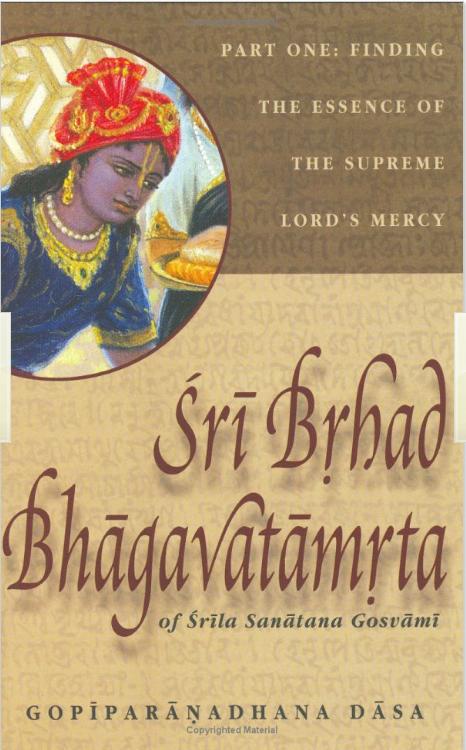
This is the 11th and final part of my review of Gopīprāṇadhan Dās’s rendering of Śrīla Sanātan Goswāmī’s Bṛhad Bhāgavatāmṛta.

2.7.115 Is a quotation from Śrīmad Bhāgavat 10.21.14 -

“O mother, in this forest all the birds have risen onto the beautiful branches of the trees to see Kṛṣṇa. With closed eyes they are simply listening in silence to the sweet vibrations of His flute, and they are not attracted by any other sound. Surely these birds are on the same level as great sages.”

Normally speaking one should not close one's eyes during sadhana due to the danger of laya and vikṣepa [falling asleep and spacing out], but I suppose the bird-like Munis in this Bhāgavat-verse are siddhas that need not fear sleep. This danger of sleep can be largely avoided if a sādhaka is allowed to get sufficient sleep - it is a myth that everyone should sleep 6 hours or less - it is medically well proven that some persons are naturally long sleepers and others short sleepers.
Sanātan Goswāmī comments: "According to the commentary of Śrīla Śrīdhara Svāmī, all sages, even if content in their own selves, should become birds in the Vṛndāvana forest." This may seem ordinary for us modern Vaiṣṇavas, but in his time, when nearly all sādhus were brahmavādīs or māyāvādīs, it was quite revolutionary. It may be one of the oldest references to a siddha svarupa.

2.7.119, commentary: "Apparently Kṛṣṇa was walking vigorously, because the kumkum became firmly attached to the grass and stones." This is not correct. Sanātan Goswāmī writes: prācuryāt sammarda viśeṣeṇa padābjayoḥ sampṛktatvāc cākṣīyamāṇaṁ sadā vana-sthalīṣu tata itaścaṁ krameṇa tābhyāṁ tṛṇādiṣu saṁlagnaṁ - 'Because Kṛṣṇa's lotus-feet intensely rubbed the gopīs' breasts and because there was so much kumkum on these breasts, the kumkum remained on His feet even though He walked all over the place with it...'

2.7.121, quoting SB 10.12.11: "These gopīs could see Kṛṣṇa only as an attractive youth (nara-dāraka). They gave no thought to His godly omnipotence. As if ordinary girls, they simply focused their attention on Him as the sole object of their desire and affection. Or— another reading—the same Kṛṣṇa who is the constant companion of the cowherd boys is also amorous appeal personified for all human females (nara-dārāḥ). Or else Kṛṣṇa figuratively tears apart all persons (narān dārayati) by filling their hearts with unique love for Him. Of course, Kṛṣṇa's attraction in the conjugal rasa is most appropriately described in relation to women, but because the gopīs presume every human being to be like themselves, they think that Kṛṣṇa tears apart the heart of everyone and fills it with love. This presumption is suggested by the use of the masculine form nara-dārakeṇa, which can be grammatically understood to include both males and females."

2.7.133, ṭīkā: "Of course the days [the gopīs] spent without Kṛṣṇa didn’t literally last hundreds of yugas, but, as indicated by the word iva [just like], such was the gopīs’ subjective experience while in the pain and anxiety of separation."

2.7.136 The gopīs were riding swings (inkana) in this Bhāgavat verse (10.44.15), but those leasurely activities are never disconnected from Kṛṣṇa as it could not stop them from drinking the nectar of Kṛṣṇa. They were going about their daily lives without it obstructing their Kṛṣṇa consciousness, as did Ambarīṣa, Prahlād and the Pāṇḍavas.

2.7.138, commentary: Dividing the phrase sva-sādhu-kṛtyam differently yields yet another understanding. su-asādhu-kṛtyam (which changes to sv-asādhu-kṛtyam) means “very un-virtuous acts.” Thus Kṛṣṇa indicates that even the things the gopīs do that lack virtue, such as behaving cruelly toward Him, are glorious."
What those cruel acts of the gopīs were is not explained; perhaps some of the harsh words they spoke to him before, in chapters 31 and 32 of the tenth canto?

2.7.140, commentary: "Kṛṣṇa assures Uddhava that even though the gopīs have for His sake abandoned loka and dharma, He watches over them and protects them. He continues to provide them the same worldly and superworldly benefits they have rejected. Thus when Uddhava reaches Vṛndāvana he will find the gopīs at home with their husbands and children, and of sane mind." Sanātan Goswāmī uses the word dhairya here [patience] for 'sane mind'. This seems to contradict this statement in the commentary of verse 141: "Unable to think and act coherently, they become as if insane." However, although the gopīs are very upset, when Uddhava comes to see them, Kṛṣṇa arranges for it that they are at least patient [dhīra] enough to hear him out, so that they understand that Kṛṣṇa cares enough about them to send Uddhava to them to console them.

2.7.144 "The moonlit autumn nights when Kṛṣṇa danced with the gopīs passed quickly for the gopīs, but not other nights. On other nights the suffering they underwent from Kṛṣṇa’s absence seemed to last millions of years. Or if we accept that Kṛṣṇa, almost every night, would find ways to sneak out of the house to meet the gopīs, then every night passed quickly, not just the nights of the Rāsa-līlā season. Only the day times were excruciatingly long." Since in aṣṭakālīya līlā there is Rāsa līlā every night this may all apply to the prakat līlā here, as described in Śrīmad Bhāgavat. This is anyway a verse quoted from the Bhāgavat (11.12.11), which deals with prakat līlā.

2.7.148 The first sentence in the commentary is by Gopīprāṇadhana; “It is obviously with irony that Uddhava speaks these words.” the word 'irony' is not well chosen, 'creating a big contrast' would have sounded better.
Further on in the commentary, "Uddhava thinks that they are Kṛṣṇa’s dearmost devotees whereas he has deviated in so many ways from the path of devotion: he has committed serious aparādhas, refused to carry out Kṛṣṇa’s instructions, and failed to develop confidence in the process of bhakti-yoga." It is not clear what this refers to, if this is narrated in other Purāṇas or it is just a statement of humility by Uddhava.

2.7.150, commentary: "In the opinion of some authorities, the Upaniṣads earned the right to become gopīs out of intense hankering to worship Kṛṣṇa in the gopīs’ special mode of prema. But this should be rejected as an untenable theory. Why? Because the Upaniṣads are inferior in devotion even to the goddess Lakṣmī. Thus the Upaniṣads, on their own merit, do not deserve the good fortune of becoming gopīs. Only on the strength of Kṛṣṇa’s special mercy could any of them ever attain that perfection."

2.7.154, end of the commentary: "Those trees cry unhappy tears because they cannot receive the nectar from Kṛṣṇa’s lips." There is bhāgya-bheda among the trees in Vraja - the trees that hang above Rādhākuṇḍa are most fortunate, because, unlike most gopas and all parents, they can actually witness Rādhā-Kṛṣṇa's jala-keli and provide shade and even ornaments (stored in their pumpkins), as well as offer seats to birds, peacocks and monkeys who can thus also witness the līlā.

Thus ends the review of Gopīprāṇadhan Dās’ rendering of Sanātan Goswāmi’s Bṛhad Bhāgavatāmṛta. 

Thursday, April 08, 2010

Bṛhad Bhāgavatāmṛta Second Canto, chapter 7, part 1

Continued book-review of the English edition by Gopīprāṇadhan Dās –

2.7.14 The verses about brahman at the end of this long commentary are about hypocrites, not about brahmānandīs in general.

2.7.29 gaja-mukta is not a pearl from the elephant's brow, according to the wiki, its dentine, not mollusk [see picture]. It is not a pearl really but a globule of ivory.

2.7.30 After musk, sandal and kumkum-tilak, we now also find a description of Kṛṣṇa's tilak being made of Yamunā-clay. Speaking of tilak, according to the Goswāmīs' books Rādhā-Kṛṣṇa do not have tilak on 12 parts of the body, only on the forehead.

2.7.48-50 Here may be the first mentioning of hiding in the lotus-patch [padma-vane lukko-curi] during water-pastimes, though here it is with the gopas, not the gopīs as in Govinda Līlāmṛta, Vilāp Kusumāñjali and Sankalpa Kalpadruma.

2.7.55 rasāla means mango. Gopīprāṇadhan could and should have known that.

2.7.69 A stava is not prayer but praise, like (the gopas chanting) "Jai Govinda Jai Gopāl!"

2.7.76. Verse: "It’s not that just anyone at any time can achieve those perfections at once just by traveling to the district of Mathurā on earth. Rather, only a rare person achieves them, when he has obtained full mercy from the Lord’s dear devotees. O mother, please, therefore, gather dust from the feet of devotees who have exclusive love for the lotus feet of the Lord."

The verse confirms one cannot just attain perfection by travelling to Vraja. The (Nāradīya, Skanda) Purāṇas say that the faithless, the atheists, doubters, hetu-niṣṭhā (ultra-rationalists), imposters, those who lust after others' wives (or go there to rendez-vous with them), travelling merchants (Garuda Purāṇa) and heretics do not receive benefit from visiting a holy place. The tīrtha yields benefit if the soul is pure, has conquered lust, fury, greed etc. The śāstras also say that one should go on pilgrimage on foot (pada-yātrā) and will have no or much less benefit if one uses a vehicle (though this has become the norm in modern days. It clearly does not feel good to sit in a taxi circumambulating Govardhana, and soon also Vṛndāvana, once this Yamunā bridge is completed). I suppose if a person is handicapped there would be more benefit in using a vehicle. Nārada Purāṇa [4.62] says that pilgrimage on the back of a bull is like killing a cow, riding on a man’s shoulder yields just half the yātrā’s benefit and travelling on foot yields four times the benefit. Nārada Purāṇa says: “If the path is gravelly or thorny one can wear shoes…” This sounds a bit strange, as I have never seen people go around Girrāja with shoes on, though there are many thorns and pebbles on the road, especially on the old dust paths. Nowadays, of course, huge roads are built to facilitate Delhi-Sunday-drivers who don’t even get out of their Humvees anymore but just cause obstruction for sādhakas doing daṇḍavat parikramā or try to go around doing their daily business in the holy dhāma. If such visitors do take a holy dip this will be their only benefit. One should also not perform tīrtha yātrā for others - the sādhaka has to do it in person. Going on tīrtha yātrā for others yields just 1/16 of the benefit. However, paying for someone else’s tīrtha yātrā will yield 4x the benefit. Makes sense…

Back to Bṛhad Bhāgavatāmṛta. Sanātan Goswāmī's commentary on the above verse says: "Only during the short time of Kṛṣṇa’s avatāra —when He makes Himself visible on earth, at the end of but one Dvāpara-yuga in each day of Brahmā— can anyone who simply visits Vraja become perfect. At that time, Kṛṣṇa  descends to earth to bestow causeless good fortune to all the jīvas. At other times, one can achieve the full realization of Kṛṣṇa consciousness only by receiving a flood of mercy from a dear devotee of Śrī Gopīnātha."

2.7.80, commentary, Gopīprāṇadhan writes: "....beyond them is the abode of liberation (mukti-pada), then comes Śrī Shivaloka, and then the spiritual world." This is wrong. Shivaloka is already the spiritual world, described here as beyond muktipada. Sanātan Goswāmī says 'tad upary eva śrī vaikuṇṭha-lokaḥ', he speaks of Vaikuṇṭha in particular, not the 'spiritual world' in general.

2.7.82, commentary: "In contrast to the tiny sky of the material world, the spiritual sky is infinite." ‘Tiny’ here means in quality, not quantity, as in the ekapāda-and tripāda vibhūti concepts - they are clearly metaphorical and ontological.

2.7.86 The Goloka where Mother Surabhi lives is the destination of fortunate cows who do not live in Mathurā-maṇḍala and associate with Kṛṣṇa and His gopas but who belong to Brahmā and other demigods. Since Kṛṣṇa  is always present in Mathurā (yatra nityaṁ sannihitaḥ), the cows with whom Śrī Gopāla-deva shares His eternal pastimes in Gokula later become eternal residents of the Goloka above Vaikuṇṭha." The Goloka mentioned in chapter 27 of the Tenth Canto had already been ascertained as this heavenly planet by Jīva Goswāmī and Viśvanātha Cakravartī in their Bhāgavat-ṭīkās.

The latter part of the 7th chapter show that Viśvanātha Cakravartī did not initiate the practise of sometimes far-fetched svārasikī vyākhyās [creative purports] - Sanātan Goswāmī was a formidable forerunner of his.

2.7.94-95 quote the two long Brahma Saṁhitā-verses at the end of chapter 5 (55-56). Gopīprāṇadhan says: "In some manuscripts of Brahma-Saṁhitā we find the variant word parama-puruṣāḥ, which is in the plural form. With that word the verse can be understood to mean either that the husbands of the gopīs in Goloka are all mahā-puruṣas, fully surrendered devotees of Govinda, or that Govinda expands Himself into numerous duplicate forms to associate with each gopī simultaneously." The words cid ānandaṁ jyotiḥ param api tad āsvādyam api ca are not clearly translated here: "The supreme spiritual entities are all to be tasted and enjoyed" - this leaves you scratching your head. The explanation of Sanātan Goswāmī is well translated by Gopīprāṇadhan and gives more insight: "In Goloka the paraṁ jyotiḥ (“supreme light”), comprising perfect consciousness and bliss, is directly perceivable (āsvādyam). This jyotiḥ can be identified either with Kṛṣṇa Himself, or with the unique prema that pervades Goloka, or even with the lamps and other sources of light in Goloka, all of which radiate absolute light and ecstasy because they emanate from the bodily effulgence of Para-brahman, Śrī Kṛṣṇa. It can also be identified with the nectar of Kṛṣṇa’s lips, which in Goloka is able to be tasted (āsvādyam) by His most worthy devotees, the divine gopīs."

Jīva Goswāmī comments on this that the luminous vastu (objects; perhaps hence the word 'entities' in the translation) in Goloka are called 'relishable' due to their transcendental nature. Then the text says, "transcendental time, ever present, without past or future, eternally exists, not subject to passing away even for the space of half a moment." - though strictly speaking this is not in the original Sanskrit, it is actually siddhānta. Goloka is an eternal now - though it is said that Rādhikā married Abhimanyu, and Her cooking was blessed by Durvāsā Muni, this actually never took place, because where there is eternity there is no past. Time in the material world causes fear but not in the spiritual sky - when Rādhā-Kṛṣṇa are in anxiety when it is time to leave the kuñja in the morning or time to leave Rādhākuṇḍa in the afternoon, this is different. This is all ecstasy, just like Their separation. na ca kāla vikrama (SB 2.9.10).

About Goloka being Svetadvīp in the Brahma Saṁhitā, Sanātan Goswāmī comments: "It is a dvīpa (“island”) not only in the sense of being a place separate from all others but also because it is a secluded place, a shelter, the residence of exalted pure souls such as Nanda Mahārāja. Like Mathurā-maṇḍala on earth, Goloka is shaped like a round island, bordered by the shores of the river Yamunā. And in Goloka milk flows so abundantly that the whole Goloka world seems to be an island floating in the middle of an ocean of milk." In Sanātan Goswāmī's original text of this comment the words 'secluded place' is not found. Interestingly a shape of Goloka is given here, which is different in śloka 2 of Brahma Saṁhitā: sahasra patraṁ kamalaṁ gokulākhyāṁ mahat padam - Gokula is shaped like a thousand-petalled lotus flower. The round shape does conform with the many diagrams the Bābājīs have made of the Yogapīṭha of Vṛndāvana, which show a globular Vṛndāvana surrounded by a semi-circle Yamunā. Whether this is really experienced by the sādhana- or nitya-siddhas that reside there.........?

2.7.99 Here Sanātan Goswāmī quotes a verse from the Bhāgavata (10.14.33):
“Yet even though the extent of the good fortune of these residents of Vṛndāvana is inconceivable, we eleven presiding deities of the various senses, headed by Lord Shiva, are also most fortunate, because the senses of these devotees of Vṛndāvana are the cups through which we repeatedly drink the nectarean, intoxicating beverage of the honey of Your lotus feet.”

In the beginning of his commentary, Gopīprāṇadhan says 'in the material world', but that is not in Sanātan Goswāmī's ṭīkā. Sanātan Goswāmī says na bhavatu puṁsām upasthendriya-dvārā tat gopīnāṁ kila sākṣād eva sampadyate - 'Men do not serve Kṛṣṇa with their genitals, but the gopīs surely do this directly and personally....." This about the men is not mentioned by Gopīprāṇadhan. Some cautious devotee leaders in the past have suggested that Kṛṣṇa and the gopīs do not have full intercourse but only kiss and caress, but it is shown here by Sanātan Goswāmī that the gopīs do engage their genitals in Kṛṣṇa’s service.

Sunday, March 28, 2010

Padmalochan

Today I was sad to hear of the somewhat untimely passing away of my old friend Padmalochan Dās. In his own way Padma Locan Dās was, along with my good old friend Rādhāraman, among my first rāga vartma pradarśaks, indicators and instigators of rāga bhakti. In my first year in Vraja he was an important source of inspiration to me. In 1974 he was one of the first westerners to settle in Vraja-dhām, which was facilitated by his being British (he did not need a visa for India at that time). 'Settle in Vraja-dhāma' means not just living in the western environment of the Iskcon temple, but also regularly living long periods of time with the Vrajabāsī sādhus.

I first met him on the very first day I ever spent in Vraja, in ISKCON’s Kṛṣṇa Balarām Mandir, Vṛndāvana, on January 2, 1981. In my Indian diary of that day I wrote:

“A small man with a beard, wearing only a chain-kaupin, comes to stand in Raṅganātha’s balcony-door. It is Padma Locana, an ex-Hell's Angel, who says he has been living in Vṛndāvana for ten years. He knows everything about Vraja, has wandered around there many times, speaks the language. He is of course a very interesting person for someone who also wants to know everything about Vraja and who wants to live there for life (me). He looks just like a bābājī, someone who stays in all day to chant and read. It is said that he chants 64 rounds each day. He has his own Rādhā-Kṛṣṇa deities and is doing no service at all in the temple. Padma Locana explains that all holy places are present in Vraja and hence there is no need to go to any other holy place. This appeals to me. He also says: "Sleeping in Vraja is samādhi, all the food of Vraja is prasādam, every word is Kṛṣṇa-kathā and every step is an entire pilgrimage." Padma Locana and Asurāri (a devotee from Luxembourg who travelled in Vraj a lot with Padma) then jest: "All the food is prasāda, all scandals are līlās, every step is a dance and every word is a song."

The following entries are some sweet memories of my first days in Vraja under the guidance of Padmalocan:

"In February, 1981, I help Padma Locana noting down and typing out a booklet he is writing about Vraja (the first edition of his booklet ‘Cintāmaṇi Dhām’). Apparently he cannot write, because he must dictate his text to me. In this way I hear all the stories about Vraja, and my desire to live in Vraja for always grows. After receiving these nectarean dictates for a few afternoons Padma Locana asks me to type them out in the Samadhi-office downstairs. When I return to Padma Locana’s room, the entire text he dictated fits just on one sheet of paper! "Well", I snigger, "we can always make it a flyer!" Padma Locana: "Or we have to add many illustrations and headlines!" Asurāri makes a very crude map of Braj Mandal for the booklet. There is nothing else but that.” (Eventually some extra text and a handy lay-out solved Padma’s problem. Padma had all kinds of manuscripts which were - in those days - rare, like Padma Purāṇa and Garga Saṁhitā, which he may have used to add more text to the booklet)"

"In Padma Locana’s room first I read the 11th and 12th Canto of the Bhāgavatam, (in those days not yet published in Iskcon and a complete novelty for a western devotee), courtesy of Gita press, and the Viṣṇu Purāṇa by Prof. Horace Hayward Wilson. We joke about the "Hindoo Mythology" Prof.Wilson talks about."

In his room Padma Locana also shows me in the Caitanya Caritāmṛta that Mahāprabhu’s mission was only a secondary reason for His descent. The primary mission was to relish rasa.

Gaura purnima 1981, March 20, 1981 -
"Padma Locan has cooked his own feast and offered it to his own Rādhā-Kṛṣṇa deities (separately from the regular temple-offering). He takes a few big karatalas and starts singing. He ends the kīrtana by singing softly and tenderly ‘Kiśori....Kiśori...’ His face is unshaven and he keeps his eyes closed while singing with feeling. Such tenderness in a Hell’s Angel? Asurāri and me fall silent in awe."

"During the annual Māyāpur-festival in March, Padma Locana takes a bus with devotees out for Vraja darśana. He allows me to join for free (otherwise it’d be too expensive) if I distribute his booklet about Vraja, 'Cintāmaṇi-dhāma'. We go to:

Gokula, where Padma explains that according to Gauḍīya Vaiṣṇava theology Kṛṣṇa was born in Gokula and that the Kṛṣṇa who was born in Mathurā merged with the Kṛṣṇa that was born in Gokula as the twin brother of Yogamāyā, after He was brought from Mathurā to Gokula by Vasudeva. We also see Brahmāṇḍa Ghāṭa, at the bank of the Yamunā, where Kṛṣṇa showed mother Yaśodā the universe.
At Rādhākuṇḍa Padma Locana tells us marvellous stories about Raghunātha Dās Gosvāmī, how he developed Rādhākuṇḍa and did his bhajan here.
At Kusuma Sarovara Padma Locana narrates that Nārada Muni got a gopī rūpa after bathing there.
At Nandagrām Padma Locana explains that this is the center of the 12 petals of the lotus of Vraja. When he leads us down we turn to the right, out of the village to Yaśodā kuṇḍa, where (in Padma Locana’s opinion) the original deities of Nanda Mahārāja are — Śrī Nārāyana and Śrī Nṛsiṁhadeva. They are both broken, are not served and are stored in a dilapidated shack. Then we turn the other direction to Pāvana Sarovara, a pretty long walk. The lake is beautiful, covered with many large trees. Here we see the bhajan kutir of Sanātan Gosvāmī.

This is common knowledge nowadays but in those days this was all news for western pilgrims to Vraja.

Sometimes I go with Kamala Carana, Padma Locana or Asurāri to Dāvānala-kunda, where Kṛṣṇa swallowed the forest fire, just opposite Kṛṣṇa-Balarām temple, through the field."

"Padma Locana teaches me: "The less the offended devotee retaliates, the heavier the reaction will be to the offense committed against him."

May 1981-
"Padma Locan’s room is a free walk-in – he does not lock the door when he leaves. Once I walk in and find a summary of Rādhā-Kṛṣṇa's aṣṭa kāliya līlā, about which I read something back in Amsterdam. The 11 mūla sūtras of Govinda Līlāmṛta, written by Śrī Rūpa Gosvāmī. Padma Locan pays Indubāi, a Vrajabāsī, to translate Govinda Līlāmṛta into English for him."

(We must remember this is 1981 - this was pioneering work - the first English translations of Govinda Līlāmṛta - like my own - were issued years later)

June 1981 -
"I get acquainted with the murderous heat of the Vraja summer and Padma Locan makes his joking version of a Brahma Saṁhitā verse – “Every step is a dance, every word is a song, and it is hot as hell!” One June-morning Padma Locana just plucks me out of my room and takes me along to the 64 samādhis, a garden opposite Vṛndāvana’s main Post Office, with countless samādhis of all the associates of Mahāprabhu, although most of the real samādhis are elsewhere.

In March 1982, during my second and last stay in Kṛṣṇa-Balarām Mandir, I went on another extended bus tour through Braja with Padmalocan.

May 1982:
"In my last days in Iskcon, when I was about to pack my bag and do full time bhajan in Vraja, Padma Locana warns me: "You can sit before the Tulasī-tree in Braj and chant the whole day, but if that is not the order of your superiors, then you will just get some sukṛti from it."

"Rādhākuṇḍa, October 27, 1983 – One afternoon I wake up (in Radhakund’s Radharaman Mandir) to see Padma Locan’s smiling face before me. He is amused when he sees my surprise. I say: "Hey Padma, long time no see!" He is accompanied by one Vrajendra-nandana from ISKCON. We go to the chatra (free food dispensary) of the Gopīnātha Mandir. Though we have to wait a long time for our roṭīs Padma Locan gives his roṭīs away (I can't remember if he gave them to me or to Vrajen though)."

"In Kartik 1986 Padmalocan arranges for a riksha to bring me from downtown Vṛndāvana to Kṛṣṇa Balarām Temple where he asks me to translate parts of Muktā Caritra and Stavamālā for him."

I occasionally met him in the Iskcon goshalla in the late 1980s for iṣṭagoṣṭhi, the last time I met him personally was in March 1991.

Padma Locan was one of the few westerners, like Sudevī [German] and Rāghavendra [Australian Rāmānandī Sādhu] who actually built up a real Indian aura. In 1990 I visited the Meera Manoranjan dharmshala at Rādhākund with him and the manager was checking every westerner for a passport, if they had residence permit, but he waived Padma, though he was English, saying 'Let him through, he is Indian....'


I will fondly remember Padmalocan for his great sense of humour - I don't know how often I rolled over the floor laughing with him. Actually his countenance was so filled with humour you had to laugh even just by seeing him approach.

Padmalocan’s health was always like a roller-coaster – sometimes you met him and he was just skin and bones, and the next time he looked like a pumpkin. He often had huge sores on his skin too. His health was weak and he had an austere constitution. I do not know what eventually led to his demise, but I’d like to say one final thanks to him for all the things I learned from him in my early days in Vraj and the sincere concern he had for me like an elder brother.

Tuesday, March 23, 2010

Bṛhad Bhāgavatāmṛta Canto 2, chapter Six

Continuation of my review of Gopīprāṇadhan Dāsa's rendering of Sanātan Goswāmī's Bṛhad Bhāgavatāmṛta-

2.6.55, purport: "Kṛṣṇa recognizing Sarūpa does not mean he fell from the spiritual world. Kṛṣṇa knows everybody anyway, be they conditioned or liberated. The original text of this purport just says prApta, Kṛṣṇa  attained Sarūpa, not that He re-cognized him, as in 're-aquaintance'. Even if the word recognized would have been there in some form in the ṭīkā, still, in the stage of sādhana the sādhaka has communicated so intensely with Kṛṣṇa that Kṛṣṇa would anyway recognize him upon arrival in the spiritual world.

2.6.62 When Sarūpa arrives in Goloka, the gopīs ask each other "ko'trāgato' 'Who has come here?" If Sarūpa had fallen from the spiritual world, they would have recognized him.
2.6.89 Gopīprāṇadhan says in the purport: "Gopa-kumāra has now assumed his original identity as Kṛṣṇa's friend Sarūpa." This 'original identity', indicating fall-vāda, or predetermined-vāda, is not mentioned in the ṭīkā of Sanātan Goswāmī.

2.6.92 and 88 seems to have inspired Viśvanātha Cakravartīpāda in Saṅkalpa Kalpadruma and Kṛṣṇa Bhāvanāmṛta - there also, by Yogamāyā's arrangement, mother Yaśodā naively considers the gopīs/mañjarīs innocent little girls. Out of vātsalya prīti for Kṛṣṇa she also considers Kṛṣṇa to be still just a little boy. The mothers-in-law may not be aware that the gopīs also massage Kṛṣṇa when they are asked to come and cook for Him. Further dalliances of Kṛṣṇa with the gopīs are described in verses 140-145. They appear to be quite intimate for Yaśodā to allow it, especially as she knows, in Sanātan Goswāmī's words, that they can never marry Kṛṣṇa.

2.6.120 Sweet rice (pāyas, paramānna or kṣīra) is always eaten warm, never cold. There isn't even any way to make it ice cold without refrigerators, whose existence is not described in the spiritual sky. Perhaps in earthen or clay pots, but even then - no śāstra speaks of cold sweet rice nor have I come across it even once in my wanderings throughout all branches of the Gauḍīya Vaiṣṇava Sampradāya in India during the 1980s decade. In September 1983 I attended a feast in Nandagrām where the sweet rice was served so hot that it wasn't possible to touch it and by the time it had cooled off we were already expected to get up and wash our hands. Now that is an extreme example, but here it is clearly stated that sweet rice must be warm (koṣṇaṁ pāyasaṁ), not cold. This is not just a local, Vrajavāsī, custom either - in Bengal also I attended many feasts at many different places, and nowhere they were serving cold sweet rice. Some say that the morale of the famous story of the brahmin from Prāg-jyotiṣpur, who burned his finger on the hot sweet rice which he offered in his meditation (see Jīva Goswāmī's comment on Bhakti Rasāmṛta Sindhu) is that sweet rice should be served cold, but that is not true - the morale is that the subtle world of meditation gets crystallized in the gross external world instead. The brahmin should have let it cool off a bit more of course, but it should have been offered warm still, not cold. Before putting the offering on the altar, the pūjārī should hold the cups with the preparations with his/her [right] hand, and if it is too hot to hold the pūjārī needs to wait before offering it, otherwise Rādhā-Kṛṣṇa-Guru will burn their delicate tongues and a sevāparādha will be made. One should never offer things one will not like to enjoy oneself and out of hunger or lust after the tasty dishes one should not rush through the offering. As for the habit of drinking boiling hot milk, the Bhagavad Gītā (17.9) says that atyuṣṇa, food that is very hot, is in the mode of passion (āhāra rajasasyeṣṭā). The end of the purport of verse 124 says: "Then the mixture is kept for some time in a vessel packed in ice." This is not in Sanātan Goswāmī's text - there is no such a thing as ice in pre-industrial pre-colonial Vraja. Kṛṣṇa is said here to start with eating sweets instead of salties - this is a Vrajabāsī custom even now. Who knows, they might have inherited it from Śrī Kṛṣṇa Himself, all those years ago! Even now, when there are Bengalis coming to Vrajabāsī feasts they give a howl of disapproval when they start serving sweets first and then the subji.

2.6.125 "Kṛṣṇa’s lovely tongue, rising to His dawn-pink upper lip while He chewed, sported within the cheeks of His lotus face" indicates that Kṛṣṇa eats with His mouth open. This (smacking the lips, flopping) is considered indecent in the West, but many items of Western etiquette are not done in Vedic culture and vice versa. Belching and passing air actually releases the life-airs during the digestive process and are healthy practises that help the digestion. Of course passing air (adho vāyu-tyāga) is forbidden in the temple and obviously in front of Guru-Vaiṣṇava too, but in solitude it is a healthy practise.

2.6.131 'In the family of Rādhārāṇī's brother' does not mean becoming Her brother yourself. This is an indication that the story of Sarūpa is fictional, but even if one takes birth in Rādhārāṇī's family it could be at most as a grand nephew, grand niece, or in-law.

2.6.136  Balarāma, according to the ṭīkā, knows of Kṛṣṇa and the gopīs' pastimes - vicakṣaṇa iti kṛṣṇasya rahaḥ krīḍāvasaro'yam ityādikaṁ jānam.

2.6.137 The pastime of Kṛṣṇa taking a stroll with the gopīs is called cankramāna in Sanātan Goswāmī's ṭīkā, and just means that they take a walk, so that it is acceptable for Yaśodā. It may be a pastime that just provides some subtle gratification for Kṛṣṇa and the gopīs.

2.6.147-155 shows how naively Yaśodā observes Kṛṣṇa's dishevelled state caused by His dalliance with the gopīs. This was later included in aṣṭakālāya granthas like Govinda Līlāmṛta and Kṛṣṇa Bhāvanāmṛta.

2.6.161 Here Kṛṣṇa gets His lunch-box along in the morning. Later Kṛṣṇadās Kavirāja, in Govinda Līlāmṛta, revealed a higher level of service, which is to send the lunch along with Dhaniṣṭhā, so that the meal is more fresh when Kṛṣṇa eats it at noon. yāta yāma - food should be eaten within three hours after it is cooked. Gopīprāṇadhan fails to mention that Sanātan Goswāmī comments on this verse that alternatively, Yaśodā may give the lunch box to Śrīdāma to carry. That makes it also better that Dhaniṣṭhā comes and brings the lunch later in the day - Kṛṣṇa (or Śrīdāma) will not have to carry it along for hours.

2.6.174 Yaśodā did not literally hold a straw between her teeth - it is a figure of speech, that she spoke in a plaintive, yet pressing manner.

2.6.177 "And she [Yaśodā], crying, milk dripping from her breasts, stood right there, motionless like a painted picture,......" later appeared in Govinda-līlāmṛta.

2.6.179 The gopīs may be able to kiss Kṛṣṇa in secret in the village, not in the open, but in the fields there is really no hiding place to even do such a thing. "According to a well-known psychological principle, nivedya duḥkhaṁ sukhino bhavanti: “Unhappy people can regain their peace of mind by revealing the cause of their distress.” But here the gopīs couldn’t even express themselves, so they remained adrift in the vast ocean of their misery.

2.6.189 Nanda Mahārāja is sending out his messengers to find out if Kṛṣṇa is safe, so one may ask here: then how can Kṛṣṇa freely enjoy Himself? I suppose here too Kṛṣṇadās Kavirāja provided a higher level of service (in Govinda-līlāmṛta)  by Yaśodā sending bodyguards like Vijay along with Kṛṣṇa so that she will not have to worry about His safety. But whether messengers or bodyguards are sent along with Him, Kṛṣṇa sheds them all at noontime and finds a pretext to go and see Rādhikā at Rādhākuṇḍa, just with some trusted friends. These messengers of Nanda may of course also be secret cronies of Kṛṣṇa, who will not tell Nanda Mahārāja of His secret exploits in the forest.

2.6.190, commentary - "The gopīs spent the entire day fully absorbed in the saṅkīrtana of singing about the Rāsa-dance and other pastimes they had shared with Kṛṣṇa." Since this takes place in the village-limits they probably did not sing too loudly.

2.6.196 - Commentary: "For all its sweetness, Nanda Mahārāja’s town is more magnificent than Vaikuṇṭha." This juxtaposition is not made by Sanātan Goswāmī himself. In the verse translation also, Gopīprāṇadhan speaks of the 'opulence' of Nanda, which does not occur in the Bengali translation.

2.6.202-3 Śrī Rūpa Goswāmī's Lalita Mādhava-drama shows that Madhumaṅgala is present in Dwārkā too, where Rādhā is Satyabhāmā and Candrāvalī is Rukmiṇī. So it should be no surprise that all Vrajaloka have their expansions in Vaikuṇṭha. The demigods' shadow-forms of the Vrajabāsīs may be like Rati-Kāma, who are said to be in material bodies but having Lakṣmī-Nārāyan within them, as is described in the comments on SB 5.18.15.

2.6.209 Here Kaṁsa is said to be an eternal associate in Goloka but in Bhakti Sandarbha 286 (a quotation there from SB 10.14.61) it is said that the demons there are just reminders of Kṛṣṇa's manifest pastimes. So I suppose that the Kṛṣṇas in the material world share this knowledge with the Kṛṣṇas in the spiritual world.

2.6.264 That the stones in Vraja actually melt is proven in Nandagrām's Caran Pāhārī, where there is a footprint of Kṛṣṇa in a stone, that melted when Kṛṣṇa played His flute there.

2.6.359 Sarūpa calls himself a newcomer (nūtnānāṁ mādṛśā), which proves he had not fallen from the spiritual world, but Gopī-prāṇadhan instead says: "Some devotees, however, can be distinguished as nūtna (“new”) because they were conditioned souls and have recently been reinstated in their original position by devotional practice and the Supreme Lord’s personal grace." This contradicts the word nūtana (new) and is nowhere in Sanātan Goswāmī's ṭīkā. He speaks there of ādhunika (new) devotees, which is the same as nūtana.

2.6.366 Both in the verse and the tika Sanātan Goswāmī says the Goloka-vāsīs don't want to go anywhere else, even if Kṛṣṇa is not present. Let alone that they become envious of Him and leave to imitate Him in the material world..... That is reiterated in verse 369, kadāpi kenāpi na hātum īśe lava leśam apyaham - 'Never, for any reason, can I give up Kṛṣṇa's lotus-feet'.

2.6.375 Is interesting, as there does seem to be some travel involved, involving time and space, while moving from Goloka to the manifest pastimes in the material world.

Saturday, March 13, 2010

Bṛhad Bhāgavatāmṛta, canto 2, chapter Five

Continuing my review of Gopīprāṇadhan Dāsa's rendering of Sanātan Goswāmī's Bṛhad Bhāgavatāmṛta -

2.5.7, commentary: "And whereas devotees of Viṣṇu see their Lord with four arms, the more intimate among the residents of Dvārakā generally see Him with only two."

2.5.12 The intimate discussion with Uddhava is about the Gokula pastimes, it is not political.

2.5.48 Sanātan Goswāmī confirms that one should not make a show of one's ecstasy - nija-bhāva-viśeṣa-prakāśa-bhayāc ca.

2.5.50 Nārada is described in the commentary as kautuki, humorous, while I always pictured him as a serious person.

2.5.52-53 "Just as the one Personality of Godhead Śrī Kṛṣṇa exists in many forms and many places, so also do we, His servants. So it is with all of us— Śrī Garuda and other attendants, devotees like Śrīmān Hanuman, and our friend Uddhava, and others too, like these Yādavas." This shows there are as many eternal associates of the Lord as there are forms of the Lord Himself.
Commentary: "Hanumān sings the glories of Lord Rāma in the Kimpuruṣa-loka of the Bhū-loka region and simultaneously in the Ayodhyā of Vaikuṇṭha. And Uddhava, whom Gopa-kumāra can see right before him, is simultaneously one of the principal companions of Kṛṣṇa in Dvārakā on earth, along with the Yādavas, the Pāṇḍavas, and others."

2.5.54 "All the Lord’s personal associates are at His hand like playthings.They are always fully dedicated to His service. Each assumes a variety of forms yet stays essentially one, just like the Lord Himself." Commentary: "So when He expands Himself and His abode into all sorts of forms, they accompany Him in suitably corresponding forms."

2.5.55 is something for those who want to dress Kṛṣṇa up with blue-jeans and mobile phone: "The abode of Mathurā, and paricchadas [garments and ornaments] like Kaustubha, Sudarśana and so, are also expanding innumerably with the Lord." In other words, these are unseparable features of the Lord. It also means that all flowers, trees and birds in Mathurā [Vraja] are not 'Indian' but reflections of the residents of the spiritual world. Recently I saw pictures of Rādhā-Kṛṣṇa deities dressed in Scottisch checkers and even as Santa Claus - this is not just mundane and ridiculous, it is even offensive.

2.5.61 Commentary of Gopīprāṇadhan:  "Although time and space do not exist in the spiritual realm, Goloka is still considered far away in the sense that the common residents of Vaikuṇṭha cannot approach it."
Though this is siddhānta, strictly speaking it is not what Sanātan Goswāmī says in his ṭīkā. He says: śri golokākhyāṁ sthānaṁ śri vaikuṇṭhād api durlabhatvena paramoccatvāt "Higher than Vaikuṇṭha means that Golok is more rarely attained."

2.5.79-80 Since Mathurā is inside Braja-maṇḍal and thus inseparable from it, Mathurā City is also situated in Goloka. It is still called Goloka instead of Mathurā because the entire realm is a land of cows.

2.5.85 'Goloka is said to be far from Vaikuṇṭha because of its laukik bandhu vyavahāra - customs of dealing with God as an ordinary friend.' This is my translation of Sanātan Goswāmī's ṭīkā. Gopīprāṇadhana's translation is a bit too generic here.

2.5.95 Why Kṛṣṇa likes to come to the material world? In Śrīmad Bhāgavat 10.14.37 it is said He gives more astonishment to His devotees there (prapanna janatānanda).

2.5.97 States that Viṣṇu sometimes does vacate Vaikuṇṭha to go to the material world. This is hard to reconcile with the eternality, endlessness and omnipresence of the Lord. Verse 101 says that Kṛṣṇa always adorns the earth with His pastimes [bhūr-loka-stham api krīḍā-viśeṣair bhūṣayet sadā) - which means He would be eternally absent from Vaikuṇṭha. There is also the ālāt cakra vāda, the concept of the Lord's manifest pastimes rotating through the material universes like a firebrand....... A possible solution to this is that Yogamāyā makes Kṛṣṇa's absence seem to last for just a moment, as it is experienced by the cowherd boys in the aṣṭa kālīya līlā. Kṛṣṇa's 5-hour excursion to Rādhākuṇḍa is experienced by them as lasting just a few moments.

2.5.104 Mahā-lakṣmī in Nanda Mahārāja's house means just her intangible presence in the form of wealth, not that the goddess of fortune, who is eternally unable to attain Vraja, would have still attained it in person. That is already denied in Śrīmad Bhāgavat 10.16.36 and 10.47.60, that would otherwise contradict Śrīmad Bhāgavat 10.31.1, where the gopīs sing śrayata indirā śaśvat atra hi, "Indirā (Mahālakṣmī) is always rendering service here" as well as Śrīmad Bhāgavat 10.5.18. We feel the wind but do not see the wind-god, similarly we see the wealth of Nanda Mahārāj in Gokul but not the personality of the goddess of fortune.

2.5.105, Gopīprāṇadhan's commentary: "And how then could Vraja be a suitable place for the Supreme Lord to enjoy pastimes as an ordinary person? Vraja is suitable because the Lord reveals those opulences only in select instances, when they are useful for His purposes. If there is no special need for them He keeps them hidden. Thus the opulences of Godhead are only occasionally seen in Vraja, though the Lord’s charming pastimes as the darling of the cowherds are always visibly expanding."
Sanātan Goswāmī says it a bit differently - svasya īsasya vihāreṣu vighnād dhetoḥ ..... tan mahā vaibhava prakaṭa rūpam aiśvaryaṁ sadā na prakāśayet - "The desire-trees do not always display their prowess for it may obstruct His [the Lord's] sweet enjoyment."

2.5.143 Mundane rockets and airplanes have their own thrusters and propellors but in the heavens and in the spiritual sky they are vimānair vāyu-vegenohyamānair divya ratha viśeṣair yānaṁ - divine chariots (not cigar-shaped vehicles like airplanes here) that are carried by the force of the wind(-god).

2.5.145, ṭīkā: "The phrase “our whole community” implies that the gopas meant to include in their statement the young gopīs but were too embarrassed to mention Kṛṣṇa’s relationship with them directly."

2.5.172 Sanātan Goswāmī's commentary: "A devotee may develop Krsna consciousness to the point of being able to see Kṛṣṇa but may not be able to see Him busily enjoying the special pastimes of Vṛndāvana (tādṛk-krīḍam) with His intimate devotees. When more advanced, a Vaiṣṇava may occasionally see Kṛṣṇa engaging in His Vṛndāvana pastimes but not displaying the full scope of His blissful enjoyment (suprasannam). And even such a Vaiṣṇava may not be fortunate enough to enter Kṛṣṇa’s eternal pastimes and play with Kṛṣṇa in absolute freedom. The highest perfection of Kṛṣṇa-consciousness is rarely achieved."

2.5.216, ṭīkā: "Others, like strict brāhmanas who eat only what they have cooked themselves and offered to their own Deities, should be given rice, other ingredients, and pots and fuel for cooking." 
The word 'brāhmana' is not mentioned in Sanātan Goswāmī's ṭīkā. Those who get the raw ingredients are a class of vairāgīs, or it is happening in a region where householders, from whom the sādhus beg, tend not to be vegetarians. The śāstra says āhāra-śuddhau sattva-śuddhih, sattva-śuddhau dhruvāsmṛtih, smṛtilambhe sarva-granthīnaṁ vipramokṣah (Chāndogya Upaniṣad VII.26.2) - 'Pure food brings pure existence, pure existence brings extensive meditation, which again frees one from all knots." When you eat your own cooked food you neither win or lose - it is just your own manovṛtti, if you eat from others you may degrade or elevate yourself (usually degrade, it is very risky because you can not see on the outside which cook is pure or impure within the heart). It is very touchy socially, because you may not want to eat the cooking of an important person (relative, devotee, employer, friend). It may appear to be proud, but actually it is a discipline. Out of humility one can also not start eating one's relatives' beefsteak, thinking 'Oh I am the lowest in the world - anyone's food will elevate me - they are all superior to me'. That is not humility, that is stupidity. One can drink juice and milk from them, or eat nuts and fruits.

2.5.219 Sanātana Goswāmī says gopayen mātṛ jāravat iti na cātra mantavyam - bhakta-vareṣu nija pratiṣṭhārthaṁ tathā syād 'If ecstatic symptoms arise that may happen spontaneously, but it should never be done for false prestige. The śāstra says one should hide it like one hides the fact that one's mother has a paramour."

2.5.221 Gopīprāṇadhan writes in his purport: "Once sādhana-bhakti has yielded its fruit—rāgānugā-bhakti, spontaneous devotion....."
There is no mentioning in Sanātan Goswāmī's verse or commentary of sādhana culminating into rāgānugā bhakti - Gopīprāṇadhan's purport is outright misleading. Sanātan Goswāmī speaks of sādhana leading to prema, not to rāgānugā bhakti. rāgānugā bhakti is itself a sādhana.

2.5.226 Sanātan Goswāmī's commentary: "According to Nārada, only those who have realized prema can distinguish its real nature. The essence of prema cannot be defined in mere words. At best it can be recognized by its secondary characteristics (taṭastha-lakṣaṇa). Thus we can understand the presence of prema by its external symptoms like trembling, floods of tears, and standing erect of the bodily hair. Softening of the heart (cittārdratā) also counts as an external symptom because it is knowable by the mind, even though it is also said to be internal because it is not a directly visible object."

2.5.234 Though this verse seems to hint at Śrīman Mahāprabhu, Sanātan Goswāmī does not mention Him in his commentary.
Gopīprāṇadhan adds: "To protect the hope of Gopa-kumāra and other devotees to obtain love at the lotus feet of Śrī Rādhikā and the Lord of Her heart, here Nārada hints at the future appearance of Śrī Caitanya Mahāprabhu, the combined form of Śrī-Śrī Radha and Kṛṣṇa. For even subtly alluding to the merciful descent of Lord Caitanya, Nārada is all-glorious."
But this is just Gopīprāṇadhan's own comment.

2.5.251, commentary: vividha jñānena manaś cāncalyāt tathā'tyantautsukyābhāvācca. bhāva-viśeṣānutpattyā bhagavaddarśane'pi tādṛśa sukhaṁ nodeti - ".....Gopa-kumāra’s simplicity allowed him to see in a very pure loving mood the Personality of Godhead. A mind filled with all kinds of knowledge becomes easily agitated by critical thoughts and is not free to enjoy enthusiasm like the mind of a simple person. Had Gopa-kumāra been more sophisticated, he would not have been able to discover the Supreme Lord in His various aspects with as much sincere affection and would not have derived as much joy from the Lord’s darśana."