Tuesday, January 31, 2006

On siddha praṇālī

On siddha pranali, Muralidhara das states today in Audarya-fellowship:

In fact there is a situation where, generation after generation, the successive gurus in various "traditional communities" of Gaudiya Vaishnavas are giving instruction about "siddha-deha" to new initiates, with the gurus telling the disciples about their own "siddha name" and "siddha form", as well as the disciple's form and name: "you are such-and-such manjari"; but in reality these so-called gurus have no real vision of either their own real spiritual form or the spiritual body of their so-called disciples. The so-called gurus haven't realized their own real "siddha form". Nor have they attained the realized the stage of Prema (pure love). But they are initiating new disciples and telling the disciple "you are a manjari and your name is such-and-such-manjari". The practices of these people are in fact a mere imitation of the practices of Gopal Guru Goswami, Dhyanacandra Goswami and other devotees of the past who had a real and direct understanding of the transcendental form of their innermost self (swarup siddha).

This is objectionable. How does Muralidhara das know whether or not these 'so-called' Gurus are self-realized and have prema or not? It is insinuating, which is dangerous in relation to Vaiṣṇavas. There lies the chance of Vaiṣṇava aparādha. Let Muralidhara come forward and tell us which 'so-called Guru' is not realized and has no prema, yet gives siddha pranali.

"In his commentary (on Bhakti Rasamrita 1.2.291), Srila Vishvanatha Cakravarti Prabhu points out that in this verse Sri Rupa Gosvami has clearly defined raganuga bhakti. Here, Sri Rupa Goswami states that those individuals who in their intrinsic nature feel an intense longing and firm attachment for service following in the wake of the feelings and sentiments of the residents of Vrindaban, with no thought or attraction for the majesties of the Godhead, are alone eligible for following in the way of raganuga bhakti. The person eligible for raganuga bhakti may spontaneously follow Sri Radha and other Gopis in madhura rati, Nanda-Yasoda and others in vatsalya rati, Sridama-Sudama and others in sakhya rati, or Citraka-Patraka and others in dasya rati."

Factually, however, Viśvanātha Cakravartī says nothing of the kind. He says:

prasaṅgato rāgātmikāyā lakṣaṇam uktvā prastutayā rāgānugāyā lakṣaṇam āha - rāgātmikāyā iti. rāgātmika bhaktau eka-niṣṭhaṁ yeṣāṁ teṣāṁ vrajavāsināṁ śrī kṛṣṇe yo bhāvas tat sājātīya bhāvāptaye lubdha ityarthaḥ.


"In the course of discussing rāgātmikā bhakti, rāgānugā bhakti is also defined, in this verse rāgātmikaika etc. The greed to attain the same feelings towards Śrī Kṛṣṇa that the exclusively fixed rāgātmikā vrajavāsī bhaktas have (is called rāgānugā bhakti)."

The word 'spontaneous' is not there, 'attraction for the majesties' is not there, nor is there any mentioning of Yaśodā, Sudāmā and Patraka etc.

Also, it is not that the siddha deha comes just falling out of the sky, like it's pure divine revelation and no sādhana or preliminary meditation is involved. Śrī Kṛṣṇadās Kavirāja has written in his commentary on Kṛṣṇa Karnāmṛta, verse 3, that in the unripe stage, preceding bhāva, one may meditate on one's own desired siddha deha -

rāgānugā mārge anutpanna-rati sādhaka-bhaktair api svepsita siddha dehaṁ manasi parikalpya bhagavat sevādikam kriyate. jata ratīnam tu svayam eva tad deha sphūrteḥ

"In the ripe stage of bhāva it becomes manifest by itself." This is confirmed by Narottama Dāsa Thākur in his Premabhakti Candrikā:

sādhane bhāvibo yāhā, siddha dehe pābo tāhā

 pakkāpakka mātra sei vicāra 


'What I think of in my sādhana is what I will attain in my siddhi. The only difference is ripeness or rawness." On the other hand again, Śrīla Jīva Gosvāmī says that one does need to be pure-hearted in order to be able to meditate on anything. So the truth lies in the middle. Nor the stern approach of Bhaktisiddhānta nor the 'anything goes'- approach of some bābājīs is balanced.

Muralīdhara then continues:

Baladeva quotes the Chandogya Upanishad, which states:
"Thus does that serene being, arising from this body, appear in its own form, as soon as it has approached the highest light, the knowledge of Self. He, in that state, is the highest person (uttama purusha). He moves about there laughing or eating, playing, and rejoicing in his mind, be it with women, carriages, or relatives, never minding that body into which he was born. - Chandogya Upanishad 8.12.3.
In his Govinda Bhasya commentary Sri Baladev Vidyabhusan then quotes the following verse from the Padma Purana:
anur nityo vyapti-silas cid-anandatmakas tatha
aham artho 'vyayah saksi bhinna-rupah sanatanah
The soul is atomic, eternal, is present by consciousness everywhere in the material body, is by nature full of spiritual bliss and knowledge, has a sense of individual identity, is unchanging, is a witness within the body, and is different from the Supreme.
Srila Baladev Vidyabhusan states that the spiritual form of bliss the liberated being attains is the original form of the soul that lay dormant within when the soul was in illusion. The Vedanta Sutra tells us that the spiritual body of the liberated being is the soul's original form. This form is a form of eternity, knowledge and bliss, as is mentioned in the verse above (cid-ananda-atma). It is not that the soul attains liberation and enters into a spiritual body or a form of existence which is an external imposition, an external state of being different from the self itsef. Not at all. The liberated soul realizes the spiritual nature of one's own inner being."


This, however, does not contradict the 'superimposition of a siddha svarūpa'. The above quotes of Narottama and Kṛṣṇadās Kavirāja make it clear that one does meditate on details of the siddha svarūpa in an unripe state. The quotes from Baladeva and the Upaniṣads simply state that the soul is unchangeable, intrinsically spiritual etc, and there is neither acceptance or rejection of meditating on the details of one's siddha-svarūpa in these quotes.

By saying It is not that the soul attains liberation and enters into a spiritual body or a form of existence which is an external imposition, an external state of being different from the self itsef. Not at all. The liberated soul realizes the spiritual nature of one's own inner being." Muralidhara contradicts himself, as in the beginning of his essay he did acknowledge the validity of the siddha praṇālī-process given by "Gopal Guru Goswami, Dhyanacandra Goswami and other devotees of the past who had a real and direct understanding of the transcendental form of their innermost self (swarup siddha)."

Saturday, January 28, 2006

Hindus, Vaiṣṇavas and the eating of meat.

While reading a thread on gaudiyarepercussions.com about meat-eating in the Vedic civilization I am wondering if the participants have ever been to India or they have any experience of Vedic life outside of Iskcon at all. No Vaiṣṇava ācārya has ever claimed that the Vedic civilization on the whole is one of pure vegetarianism, nor are Vedic- and Vaiṣṇava culture totally identical or even compatible. One who has lived in India will surely know that most Hindus are not vegetarians, though they will abstain from beef. Scriptures like Harivaṁśa and books about Rāmacandra (haven't seen that myself though, so I can't confirm or deny it) and Brahma Vaivarta Purāṇa (that I did read) may have described Rāma or the Brajabāsīs eating meat. One must understand here that, at least the Brahma Vaivarta Purāṇa (which I can judge) is a Purāṇa in the mode of passion (rajo-guna) and that colors its subjective depiction of Kṛṣṇa līlā as well.

However, the books quoted in that thread are not quoted in the Gosvāmīs' books. nānā śāstra vicāranaika nipuṇau saddharma saṁsthāpakau (Śrīnivāsācārya's Ṣaḍ gosvāmyaṣṭakam - 2) "The Gosvāmīs were expert in scrutinizing various (not all) scriptures to establish the sad-dharma, the true religion." The outcome of their studies is that meat, fish and eggs are not served during Vaiṣṇava feasts, not in Iskcon, but also not in the Gaudiya Maṭha, with the bābājīs, Gosvāmīs or anywhere. It is also mentioned in Bhagavad Gītā (9.26) and the Bhagavat (1.17.38. śūnaḥ prāṇī-vadhah...adharma - 'killing other living beings is adharma', Viśvanātha ṭīkā) that a Vaiṣṇava is to be a vegetarian. Nobody has ever claimed that Vedic civilization itself is or has ever been vegetarian.

Thursday, January 26, 2006

Mahāprabhu about respect in general

From Caitanya Caritāmṛta (Antya 4. 135-169) we learn that junior devotees should not instruct senior devotees. In this narration we see that Jagadānanda Paṇḍit advised Sanātana Gosvāmī to go to Vṛndāvana, but when Mahāprabhu heard that he was very angry, because Jagadānanda Paṇḍita was junior to Sanātana Goswāmī not just vyavahāre, materially, by being younger in age, but also paramārthe, spiritually, because Sanātana Gosvami was like his Guru (CC Antya 4.159 vyavahāre paramārthe tumi - tāra guru tulya). Mahāprabhu thus set the standard for devotees of all time to act according to maryādā, or protocol. He will be very angry when junior devotees instruct senior ones - maryādā laṅghana āmi sohite nā pāri (C.C. Antya 4.166) "I cannot tolerate breach of the protocol."

One should note, however, that if a devotee senior in age is inferior in spiritual advancement one need not heed the instructions of such a senior devotee-by-age-only. After all, Mahaprabhu said of Sanātana Gosvāmī: kāhā tumi - prāmāṇika, śāstre pravīṇa; kāhā jagā - kālikāra batuyā navīna (CC Antya 4.167) "Where are you, expert in the scriptures and a great authority, and where is Jagadānanda in comparison, a new student?" Sanātana Gosvāmī was not just superior in age.…….

This paragraph is added to the end of my essay 'Who or what is a brahmin or a Guru?' on the 'Articles'- page of www.madangopal.com

More cautions by Śrīla Jīva Gosvāmī

Śrīla Jīva Gosvāmī said in Gopāl Campū (1.23.1) that the Rāsa-līlā is for private discussion, not public hearing: tad etad govinda vraja vijana kāntānuvacanam dadhadbhir yogyasya śravasi param arpyam na sadasi - 'This confidential Rāsa-līlā topic is to be heard by qualified people who carry Govinda in their hearts, not in a public assembly."

This cautionary note is added to the footnote on page 6 of my essay "Qualification for Raganuga Bhakti" under the linktab 'Articles' of www.madangopal.com.

Friday, January 13, 2006

Regrets

I remember that, in 1988, when the late Rohiṇīndranāth Mitra of Keśī-ghāṭ found out that I had translated Govinda Līlāmṛta into English, he told me: "Very well done. And now you please put this book away." Then he went on reminding me how Bhaktisiddhānta Sarasvati did not want his followers to read Ujjvala Nīlamaṇi and the like. I remember in 1983 Sādhu Bābā told me not to read rasika books if/when I was in a non-celibate state (he also told me not to go out of our āśram as Navadvīp is full of sahajīyas). Nevertheless I continued to read, translate and distribute rasika kathā. Now self-confessed sahajīyas like Pītāmbar Dās and Jagadānanda Dās are reading and passing out these books to wholly unqualified people. I feel some burden of responsibility here; I was too liberal in the past. Now what to do? When you fired the gun you cannot call back the bullet anymore!

Of course many people also express gratitude at my translation work and some people will benefit from it, but the harmful side-effect of that past 'mission' of mine is that people who do not realise the spiritual nature of Rādhā and Madangopāl's loving pastimes are reading them and are - deliberately or otherwise - misrepresenting them. I deeply regret that....

Tuesday, January 10, 2006

Orthodox

Trying to place the modern western term 'orthodox' into Vedic/Indian/Vaiṣṇava perspective has proven interesting and flattering indeed. The English-Bengali dictionary translates it into naiṣṭika, which is also a Sanskrit word. bhaktir bhavati naiṣṭhikī (S.B. 1.2.18) naiṣṭhikī niṣṭhā cittaikāgryaṁ tāṁ prāptā - "naiṣṭhikī means attaining niṣṭhā or a fixed mind." (Viśvanātha Cakravartī's ṭīkā) The V.S. Apte Sanskrit dictionary translates naiṣṭhika back into English as follows - "Final, last, concluding, decided, definitive, conclusive, fixed, firm, constant, highest, perfect, completely familiar with or versed in." Next time folks call me orthodox, I will blush of shyness at the flattery....

Wednesday, January 04, 2006

Advaitācārya, the greatest Guru of madhura rasa

Today, as I browsed through Murāri Gupta's 'Caitanya Carita Mahākāvya', I found a beautiful verse in the introduction (1.20) which ends with this line:

śrī-yuktādvaita-varyaḥ parama-rasa-kalācāraya īśo vireje

(Syntax: śrī-yuktaḥ = resplendent; advaita-varyaḥ = the superexcellent advaita prabhu; parama = the supreme; rasa = relation with God; kalā = the arts; ācārya = teacher; īśaḥ = God; vireje = shines.

"The most glorious Advaita Ācārya is the Supreme Lord and the greatest teacher of the supreme rasa  (the divine amorous flavour in relation to Śrī Kṛṣṇa)."

This adds to the existing evidence that Advaita Ācārya is indeed the bestower of madhura rasa, despite claims to the contrary. This line has been added to page 1 of my essay 'In defense of the Advaita Vaṁśa' at the linktab 'Articles' on http://www.madangopal.com/.

Tuesday, December 20, 2005

Sītā Caritra and Nandinī-Jangalī

Thanks to Yadupati for sending me an essay by Rebecca J. Manring, called Sita Devi, an Early Vaishnava Guru, about Sri Sita Devi, the spouse of Advaita Prabhu. Here are some interesting paragraphs from it, explaining the origin of Nandini and Jangali, the ‘cross-dressing’ disciples of Sītā-devī, which were mentioned in Prema-vilāsa and Advaita Mangala, stories that were quoted in my book ‘The Glories of Sri Advaitacarya’:

“The author of the Advaita Mangala even describes the first feast Advaita Acharya held after his marriage, to introduce his disciples to his new wife. The texts in fact state that Sita treated these boys and young men as if they were her own sons. And so it would not have been much of a stretch for these students to take the next leap of faith, once their guru had departed, to align themselves with the person who was closest to that guru in some clearly visible ways — his widow. That is apparently exactly what happened: Her husband’s students, her foster sons, in a sense, shifted her into the position of authority recently vacated by her husband.”
……………….
“According to Lokanatha Dasa’s Sita Charitra, her problems begin when two male seekers—Yajneshvara and Nandarama—approach her for instruction, and she is obligated to refuse them on gender grounds. Their story is rich in clues to Sita’s theological identity and the ways her movement chose to accommodate and contain that identity. Nandarama is a brahman, and his friend Yajneshvara is a shudra (the fourth major caste group) from a farming family. Both are great devotees of Krishna, and have decided to seek out a suitable guru. Nandarama remembers having been given a mantra some time previously by Sita, in Shantipur, so the pair set out in search of her. Sita greets them warmly, but tells them that she can only teach other women. Nevertheless she gives them the Radha mantra and some rudimentary advice: to worship Radha and Krishna, visualizing themselves as attendants in the divine couple’s trysting place.”

(Commentary by Advaitadas: This is odd, because the Advaita Vaṁśa does not bestow initiation in Rādhā mantra. It could be Sītā-devī’s personal gift to these two devotees, a special case to accomplish the following līlā:)
……………..
“The two disappear, only to reappear a short time later dressed as gopis, the young cowherd women of Vraja who were Krishna’s close friends and lovers, complete with braided hair, anklets, bangles, skirts and bodices. They announce that the practice of repeating Radha’s mantra has effected a sex change in them. This is an amazing claim!”
……………..
“Not satisfied simply to take their word that the two men are now women, Sita examines the evidence, Lokanatha writes, and then agrees that she can now instruct them. And from this time on Nandarama and Yajneshvara are known as Nandini and Jangali, and live out the remainders of their lives as women. So great was their devotion and their desire to learn from Sita rather than from any other guru that these two were willing to relinquish their very maleness to do so.”
…………………
“The author of the Sita Charitra, writing at a time when the sakhi bhavas were coming under sectarian assault, used Sita’s hagiographical image to define the sakhi bhavas as women and then to connect their sect to a venerable branch of the greater Gaudiya Vaishnava community.”

(Commentary by Advaitadas: With sakhī bhāvas the author means sakhī bhekhīs, men who dress like gopīs. Nandinī and Jangalī are not sakhī bhekhīs, because they actually had a gender change. Sakhī-bhekhīs are physically men, though some go as far as castration, but they never mystically change gender. The author mentioned in the previous paragraph: “Sītā-devī examines the evidence”, which means that an actual gender change took place, and this must have been a mystical sex change caused by their practice of the Rādhā-mantra, because in those days no surgeon would have had the know-how or the instruments to perform such an operation on them. Concluding statement: The members of the Advaita Parivāra are not cross-dressers - the above pastime is a special Līlā performed by Sītā-devī and her disciples, it does not stand as a general rule. I just posted this story because it was new to me and sheds more light on the origins of Nandinī and Jangalī)

The author informed me that unfortunately she has no copy of Sītā Caritra herself, otherwise I would have asked her to send me a copy and much more may have been learned about Sītā Devī.

Tuesday, December 06, 2005

Remembering the perfect gentleman

My friend Madanmohan quoted this brilliant verse from Śrīmad Bhāgavata 4.17.20 -

praharanti na vai strīṣu kṛtāgaḥsvapi jantavah
kim uta tvad vidhā rājan karuṇā dīna vatsalaḥ

“People do not beat women, even if they have done wrong. What to speak of persons like you, O king, who are so compassionate and kind to the poor?"

(Goddess Earth to King Pṛthu)

This reminded me of an incident in Sādhu Bābā's līlā, so I added this text as a footnote to his biography, page 52. See link tab Nikunja Gopal Gosvami on www.madangopal.com

Monday, December 05, 2005

Intellect led by śraddhā

From a recent lecture by Swami Tripurāri in the USA:

“On symbolism and Kṛṣṇa līlā, Swami said this morning that it is unavoidable that we will project symbolic meanings into a world beyond intellectuality. Acaryas such as Sanatana Goswami too questioned the līlā in the same way or even more intently - these were highly intellectually inclined personalities.”

While the whole lecture of Swamiji was marvellous, I beg to place a question mark here – in what way did Sanātan Gosvāmī "question the līlā" at any point? Am I not reading the Swāmī here properly?

Swamiji continues: “But they were primarily bhaktas, and they worked their intelligence into the essence of these narrations and brought their refined understanding back to us. So intelligence is necessary but, intellect is a razor’s edge that can greatly help just as it can greatly harm……some devotees have difficulties in their spiritual lives precisely due to too great intellectual activity. He explained that intelligence is a part of ego that has to be left behind just as any other part.”

Yes, I believe that the problem with many Indian Vaiṣṇavas is under-education, which leads to racism, tribalism and blind acceptance of hearsay, and the problem with many western Vaiṣṇavas is over-education, which leads to shoreless blabla, speculation and arrogant challenging of the śāstras.

Swamiji: “From this presence of Kṛṣṇa a different kind of intelligence comes into play. Intelligence is then spiritualized, functioning under the jurisdiction of the heart, of śraddhā. “

This is corroborated in the Gita (10.10) bhajatam prīti pūrvakaṁ dadāmi buddhi yogaṁ tam.

Swamiji: “From such position one will understand śāstra progressively. In such a position one will be nipuna, brilliant in understanding, creative in presentation, a scriptural genius. Understanding of śāstra then will not be limited but expansive and comprehensible, not intellectual and reasonable only, but mystical in nature, capable of transformation and revolution. This has been shown by our acaryas. Intelligence rooted in faith may appear to some as arrogance and pride. Such misunderstanding of the devotee’s words and actions can come from intellectual activity taking precedent over faith. “

Right on. The Gosvāmīs have shown through their books that an intellectual can also have simple faith and need not be an arrogant challenger of authority.

Tuesday, November 29, 2005

The Wrong Road

From Jīva Gosvāmī's Bhakti Sandarbha 238 -

guror apyavaliptasya kāryākāryam ajānataḥ
utpatha pratipannasya parityāgo vidhīyate

Synonyms : guroḥ - Of the Guru; api - even; avaliptasya - of the arrogant; kārya - to be done; akāryam - not to be done; ajānataḥ - not knowing; utpatha - wrong road (deviant); pratipannasya - of the ascertainment; parityāgaḥ - wholly rejected; vidhīyate - compulsory.

"One must wholly reject the Guru who is arrogant, who does not know what is to be done and what is not to be done and who is deviant."

The word ut-patha means 'the wrong road', 'off the track', 'evil ways' or 'deviant'. Having lost the way, either deliberately or out of ignorance. So any Guru who deviated from the six Gosvāmīs and other foundational ācāryas' teachings must be rejected. This is an elaboration on Jīva Gosvāmī's own edict 'vaiṣṇava vidveṣī cet parityajya eva' - "If the Guru is a Vaiṣṇava-hater he must be fully rejected."

But there is more to it than that - with the word utpatha the parameters are widened. If he lost the way he should be wholly rejected, too.....

Saturday, November 19, 2005

Mādhurya Kādambinī

The new English edition of Mādhurya Kādambinī should be on sale now, so I withdrew my translated and edited version from my book catalog as promised to Rasarāja Dās on November 9th. (A new catalog was uploaded today to www.madangopal.com). I have read about 150 pages of the book so far. Jagad and Mādhava have certainly done a good job on the editing and lay-out respectively. Unfortunately it is material perfection only, which is largely undone by the (faithless and offensive) mentality of the two. Unfortunately it is the translator's attitude to which the reader of a translation is exposed, not the attitude of the original author. It is always like that. It is the attitude that a devotional book breathes out which will win the hearts, not the perfect language or the perfect lay-out. Besides, Jagad can't help using his irreverent scholarly language, calling Śrīla Viśvanātha Cakravartīpāda repeatedly just 'Visvanath' as if he is his classmate or so. Also translating the word ' jñāna' as ' gnosis' is a bit too Theosophical I think.

Sunday, November 13, 2005

Utthānaikādaśī - end of Niyam-sevā

Niyam Sevā 2005 completed successfully, without lapses - 30 days Rādhākund-vāsa, Dīp-dāna, and no ponghots at all (partly due to being sick, but still...)

November 12 - Utthānaikādaśī -
Everywhere people walk around with long stems of sugarcane. Viśvanāth closes his series of Vidagdha Mādhava-pāṭhs.

November 11 -
Two days before the end of Niyam-seva I finally start to attend the Kunjabhanga kirtans at Śyāmasundara Mandir. Amruds are back in season - yummy! Just before the end of Niyamseva I complete (the gist of) Rādhā-Govinda Nāth's C.C. Antya līlā -.

Studies of Rādhā Govinda Nāth's commentaries on Caitanya Caritāmṛta -

Antya 20.12 - pratipadaṁ pūrnāmṛtāsvādanam - Mahāprabhu got the full relish of even just 2 syllables - ja ja ga ga. Not even the full name Jagannāth!

vidyā-vadhū - vidyā = kṛṣṇabhakti. A bride is tender, always serving, sweet, always smiling, satisfied and always tries to conceal herself, and those to whom queen Bhakti appears, also become like that.

Antya 20.22 - Rādhā-Govinda Nāth: 'Grass feeds cows and thus serves the Lord, but I am lower than that, because I cannot serve in that way."

Antya 20.37 - Mahāprabhu told Sītānāth to bestow prem on Rūpa and Sanātan in Caitanya Bhāgavat, Antya 9 -'amāyāy kṛṣṇa bhakti deho e donhāre'.

As the honeybee is the only creature able to receive honey from the lotus, the bhakta is the only one to receive prem from Kṛṣṇa.

Antya 20.55 - "Other girls cannot serve Kṛṣṇa - they may hurt Him with their bangles!"

Antya 20.57 - When the sun was blocked by the chaste wife, Brahmā Viṣṇu and Śiva promised her that if she would allow the sun to rise her husband would be revived, with a healthy body and no more attachment to the prostitute.

Wednesday, November 09, 2005

Gopāṣṭamī

November 9, 2005
Gopastami
Rādhārāṇī's annual Caran Darśan. Goṣṭha-līlā kīrtans in Gopīnāth- and Śyāmasundar Mandirs. Rasarāja gives me a copy of the newly printed English Mādhurya Kādambinī, he says there are no immediate plans for further publishing (of new titles) for now.

November 8, 2005
I meet Rasāmṛta, who was thrown out of Gauḍīya Discussions for helping me defend the Gosvāmīs and the Bhāgavata against Jagāi and Mādhāi. He says he did not want to post anymore after and because of such behavior.

Yadunātha tells me that Rohini serves Śyāmakund by cleaning its steps with a pooper-scooper.

November 7, 2005
I dreamt tonight that Bābā had come back...

The 12th day of this bout of cold. In despair I walk to Gauradhām hospital, where I get tabs that cure somewhat. Half of my trip (27 out of 54 days) lost in illness. So sad, as I looked forward to this trip for 6 months (in perfect health).

November 5, 2005
The trip to Vṛndāvana is wholly in vain, materially and spiritually (as far as anything in Vraja is in vain). Parimal Bābu does not have the texts I am looking for - he has four notebooks full of beautiful kathā, but none of it is named. It is from Ānanda Gopāl Gosvāmī's time though (1943), but most of the topics wouldn't fit into our upāsanā, so its unlikely to be his.

Studies of Rādhā Govinda Nāth's commentaries on Caitanya Caritāmṛta -
Antya 19.53 - govinda - "You always protected our senses with Your flavor, touch, sound etc.How can we gopis survive in separation from you? Dāmodar - Remember once those who are bound with ropes of affection to you! mādhava - Even Lakṣmī devī cannot tolerate separation from You! So she always dwells on your chest as a golden stripe. How can we simple girls then tolerate the pain of separation from you? You must protect us! Or: You are not () our husband (dhava), so you cannot do with us whatever you want!"

Antya 19.63-64 Perhaps Mahāprabhu was into vāsaka sajjikā bhāva and wanted to eagerly go out of the kunja to see if Kṛṣṇa was coming.

Antya 20.8 - Mahāprabhu chanted hare kṛṣṇa out loud, as in Baladeva Vidyābhūṣaṇa's tika of Stavamālā - hare kṛṣṇeti mantra pratika grahanam. ṣoḍaśa nāmātmana dva-triṁśad akṣarena mantrena uccair uccāritena sphurita kṛta nṛtya rasanā jihvā yasya saḥ "He made His tongue dance with the 32-syllable, 16-word Hare Kṛṣṇa mantra."

Sanātan Gosvāmī's ṭīkā to HBV 11.247 - vācikasya kīrtanāntargatatvāt mānasikasya ca smaraṇātmakatvāt. Real japa is upaṁśu - vocal japa is counted as kīrtan and mental japa as smaraṇa. But for that one needs a pure and steady mind.

Saturday, November 05, 2005

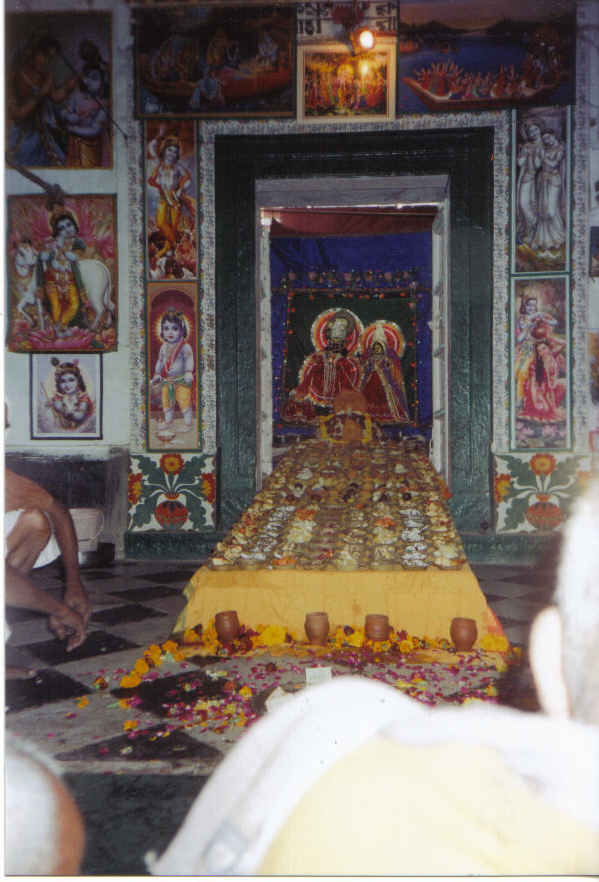
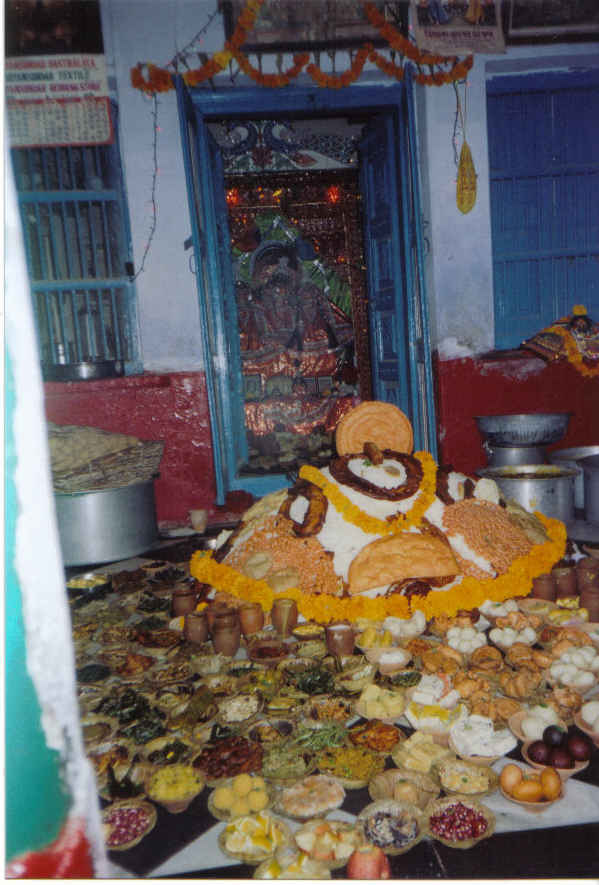
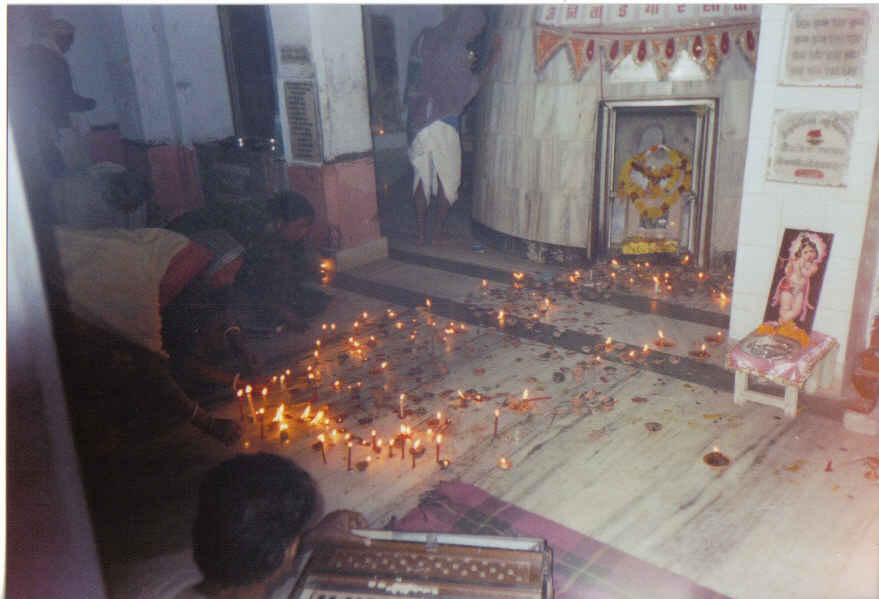
Diwāli's 4 milksweets


Annakut at Amiya Gopal's


Annakut at Govinda Mandir


Diwāli at Raghunāth Dās Gosvāmī's Samādhi.


November 3, 2005
Unexpectedly Parimal Viśvāsa visits me at night. He doesn't know if the manuscripts I look for are with him. He got them from his grandmother. He is himself a śiṣya of Ananta dās Bābā from Govinda Kund.

November 2, 2005
Due to eating some sweets late last night I wake up with a head full of mucus. I have darśan of only the main Annakuts and eat just a small amount of Girirāja's prasād, that are free from dairy products. Giridhārī misses the abhishekh, but the caraṇāmṛta would have increased my mucus anyway. I sleep for 28 hours.

November 1, 2005
Diwāli on the bank of the kund is, like Bahulāṣṭamī, less crowded than in previous years.

Studies Rādhā-Govinda Nāth's commentaries on Caitanya Caritāmṛta 
Antya 18.18 - Prema dances on the waves of joy and sorrow, separation and meeting, vāmya and dākṣiṇya, softness and hardness, the 20 bhāvas like kila kiñcit, sañcārī bhāvas etc. All this is caused by prema.

ek ṭhāi - In Braja, or within Mahāprabhu (does he refer to the Rādhā-Kṛṣṇa milita tanu here??)

Antya 18.79 - ardha bāhya is like waking up from a dream - one is just returning to the 'real' world and is still half dreaming too.

Antya 19.46 - A child cannot make a house - it would be unfit to live in, especially in the long term. Fate also is unable to create lasting and successful love-affairs.

Antya 19.38 - The moon doesn't illuminate the caves' interiors, but Kṛṣṇa's moon-like face shines in the caves of the people's hearts, destroying the darkness of sorrow there.

Antya 18.98 - virodha alaṅkāra is an apparent, but not real contradiction - virodhaḥ sa virodhābhāḥ virodhābhā iti na vastuto virodhaḥ virodha iva bhāsata ityarthaḥ (Alaṅkāra Kaustubha 8.26). Generally friends don't attack friends and no one protects an enemy. But actually there's no contradiction, because Kṛṣṇa's hands attack the gopīs' breasts, and the gopīs protect them with their hands, that is natural.

Wednesday, October 26, 2005

Rādhākund Snān

I meet my Gurubhāi Ṛtu Vijay, who says he lived with me in the āśram, but that escapes my memory. He lives in Bahulā-van with Brajabāsī Gurubhāis.

October 25
There is a clear decline in the number of Bahulāṣṭamī-bathers - it's much less than last year.

October 24
A new concrete casing is made around Bābā's smṛti-phalak.

The eve of Rādhākuṇḍa-Snān is cosy. In the Samādhi Mandir an unlikely alliance of Aindra's Iskcon kīrtan-group with Brajabāsīs raises the roof there, while Anup Gosai enters the village from the other side with his supporters holding a banner with his name on it. Like most other devotees, I don't bathe at midnight but just go to bed.

October 23
In Kṛṣṇa Bhāvanāmṛta, Śrī Rādhikā complains that after the light has shone, the darkness gets even deeper. I experience that in the material sense when I drive back to Rādhākuṇḍa on the bike in the dark. When a tractor with its big light on drives towards me I get blinded and when it passed by I see even less in the dark than before.

Studies - Rādhā Govinda Nātha commentaries on Caitanya Caritāmṛta -

CC Antya 14.45 - dwādaśa is the name of a yogi's daṇḍa.

CC Antya 14.67 - Now the object has outgrown its vessel. Rādhā's bhāva is able to tolerate the whirlwind of rādhā-bhāva, but Kṛṣṇa (as Gaura) isn't. Rādhā is a solid gold vessel and Kṛṣṇa a gold-plated copper vessel. mādana mahābhāva is like nitric acid, which a solid gold vessel can easily handle, but a copper one cannot. Rādhā's complexion is a protective shield. In Braja Rādhā-Kṛṣṇa are separate entities, but in Gaura līlā they are joint, that's why Gaur's bones slacken (?) From here on Rādhā-Govinda Nāth gets very confusing. Rohiṇī-nandan calls it 'unnecessary comments'. The point is, Gaur isn't Rādhā but Kṛṣṇa with Rādhā's bhāva, going through a learning process - He discovers Mahābhāva. Hence Rādhā-Govinda Nāth's bewildering comparisons (not mentioned in this blog) don't work. Why is there otherwise Gaur-līlā? The vikāras take place because Kṛṣṇa learns mahā-bhāva for the first time.

Sunday, October 23, 2005

A land of thieves

In the evening Navadvīp Gosvāmī, the grandson of Tinkuri Gosvāmī, shows me he only got a tiffin with some prasād and no dakṣinā from Mathurā Prasād. He affectionately consoles me that in a 'corer desh', a land of thieves, this is a donation to a Brajabāsī. At least Giridhārī, Bābā, my mother and myself get a big feast today. Navadvīp Gosvāmī invites me for a kīrtan in front of Tinkuri Bābā's āśram. They do sing the name of the Guru in kīrtan, like in Iskcon, too.

Studies -
CC Antya 5.82 - Rādhā Govinda Nāth - nija labhe mane - It's an exchange of love between the Lord and the bhaktas as in Gītā 4.11 - ye yathā māṁ prapadyante.

CC Antya 5.118 - Once a rich devotee had abhiṣekh done of his deity as a part of its installation. He asked the pujārī to do the abhiṣekh for the 2nd time, and only when he saw the deity blinking His eyes, as ordinary people do when they are showered, he had the abhiṣekh stopped, knowing that now Kṛṣṇa was really present in the deity.

CC Antya 6.9 - Mahāprabhu is only occasionally in Kṛṣṇa-Bhāva - His Rādhā-bhāva is predominant. Also, the gopis went into Kṛṣṇa-bhāva when Kṛṣṇa left them during the Rāsa-dance.

CC Antya 6.47 - Nitāi called Raghunāth Dās Goswāmī a thief because he tried to attain Gaura without first taking shelter of Him (Nitāi).

October 21 - Vaiṣṇava pada Dās tells me that Ānandī is not the same person as Prabodhānanda - he lived in the 18th century. He didn't write a tika to Rādhā Rasa Sudhānidhi because that, plus Vilāp Kusumāñjali, was locked up until just 50-70 years ago!

CC Antya 6.169 - chale - Mahāprabhu earlier told Raghunāth Dās Gosvāmī (Madhya 16) that Kṛṣṇa would show him the trick to escape. That is now happening. Kṛṣṇa made Yadunandanācārya forget the possibility that Raghunāth could escape.

CC Antya 6.198 - śuddha vaiṣṇava nohe - They tried to tie Raghunāth down by marrying him with an attractive teen and they withheld 8 lakhs of Rupees from the Governor for their own use.

Antya 6.236 - One should not eat nicely, because prasād is for honoring, not enjoying. The sun-rays are straight, but may get crooked when they are reflected on a crooked object. Similary prasād is pure, but the way in which we eat it may not be. Haridās Thākur honored prasād by just taking a little piece (Antya 11.20)

Antya 10.8 - Disobedience can be pleasing. If I am sick and I tell my relative to go to sleep but instead my relative stays up all night to nurse me, that is very pleasing. Nitāi's example should not be imitated by ordinary sādhakas, though.

Antya 12.118 - 'I actually brought the oil for you, but since you don't accept it, it is as if I didn't bring it at all."

Antya 14.23 - According to Rādhā Govinda Nāth Mahāprabhu didn't mind the Oriyan woman mounting his shoulder because he hadn't yet returned from an āveśa in Rāsa līlā. Whereas he was grateful to Govinda for stopping him embracing the deva dāsī who sang Gita Govinda.

Antya 14.34 - Kṛṣṇa held no flute and Subhadrā and Balarām were there, so Mahāprabhu's vraja-āveśa was broken.

Thursday, October 20, 2005

Bābā's tirobhāva

My feast for Bābā's tirobhāva and my mother's memory is more or less a feast for Mathurā Prasād and his clan. I don't see any other invitees taking prasād. First rabari, then puris - Brajabāsī style! Rādhā-charan Pānḍā doesn't show up. I present sweets to my friends too.

Gauḍīya Maṭh's B.P. Puri Mahārāj says that mediating on a gopī-body in an unripe stage results in a material woman's birth, but Kṛṣṇadās Kavirāj writes in his Sāraṅga Raṅgadā-ṭīkā to Kṛṣṇa Karṇāmṛta that one should meditate on one's own desired siddha deha also before rati (the stage of enlightenment) is there. So what will happen with all those who follow Kṛṣṇadās Kavirāja then?

October 19, 2005
Rādhācharan Pāṇḍā isn't pleased that I hold Bābā's virahotsava in Mathurā's place. When I tell him we can do it in his place next year he says: "Who knows who will be around then?" It's embarrassing.

Studies -
CC Antya 4.221
Rādhā-Govinda Nāth thinks that Gopāl Bhaṭṭa Goswāmī had already compiled a Vaiṣṇava Smriti, so Sanātan Goswāmī was satisfied that Mahāprabhu's order to him (Sanātan) was already fulfilled and he just wrote a ṭīkā.

CC Antya 5.17
abhyaṅga, according to Viśvanātha Cakravartī, is a massage with oil and turmeric - abhyaṅgena taila haridrādinā mardanam.

CC Antya 5.20
Rāmānanda Rāy projected the role of Rādhā-Kṛṣṇa upon the dancing girls, to keep them in respect, just as Braja's audiences worship the Rāsa-līlā-actors as swayam Rādhā-Kṛṣṇa. He projected a maidservant-mood upon himself, in order to render all the intimate services to the girls - being another girl serving girls.

Tuesday, October 18, 2005

Candragrahan - Rādhā-Govinda Nāth Antya 4

This time, for the candragrahaṇa, it's easier to finish puja in time. The grahaṇa is now in the early evening, for just 24 minutes. The Brajabāsīs jump into the kund afterwards with all their clothes on. This time it's dark during the snāna. After this, all is illuminated by a strong full moon.

Studies -
Rādhā-Govinda Näth, CC Antya 3.260
Previously Brahmā was deluded by māyā and ran after his own daughter, but now, in Gaura-līlā, as Haridās Thākur, he was the heir to prema-bhakti and defeated Māyā, becoming her Guru.

Antya 4.131 iha loka, para-loka - By failing to offer respect one becomes condemned in this life and thus loses one's bhakti, and this again causes great suffering in the next life.

4.159 vyavahāra - pāramārthik - Sanātan Goswāmī was senior to Jagadānanda Paṇḍit both in age and in bhakti. 4.161 saubhāgya, and 4.163 ātmīyatā sudhā-dhārā - Parents chastise their own child, but not others' children. Punishment is a sign of intimate love.

4.166 - Mahāprabhu was really angry with Jagadānanda Paṇḍit, and confirms how important maryādā is to Him - maryādā laṅghana āmi nā pāri sohite. " I cannot tolerate breach of the protocol."

4.171 - Jagadānanda Paṇḍit is Satyabhāmā, with samañjasā-rati, but Sanātan Goswami was Labaṅga Mañjarī, with (superior) bhāvollāsa rati.

SB 10.29.34 - Viśvanāth Cakravartī on vicikirṣito - nirguṇaḥ kartum ārabhyamānā eva sa śanaiḥ śanair bhaktyābhyāsavān niṣṭhā rucyāsaktir iti bhūmikārūḍha eva samyak nirguṇaḥ syāt " Getting a spiritual body is a gradual process, leading through to niṣṭhā, ruci and āsakti."

Sunday, October 16, 2005

More studies of Rādhā-Govinda Nāth

More studies of Rādhā-Govinda Nāth's commentaries on Caitanya Caritāmṛta - He considers doing kirtan for money the nāmāparādha 'considering harināma a mundane pious activity' or karma-yoga.

Antya Lila 3.164 -
The whole village had to suffer along with Rāmcandra Khān because they tacitly condoned his aparādhas to Haridās Thākur and Nityānanda Prabhu. (parokṣa anumodana) If they were afraid to stand up to him because he was in charge of the place then that was due to bodily consciousness.

Ajāmila did lots of nāmābhāsa before his death too, by calling his son Nārāyan, but that never destroyed his tendency to sin. Only his deliberate bhajan at Gangadwār after being freed by the Viṣṇudūtas purified him forever.